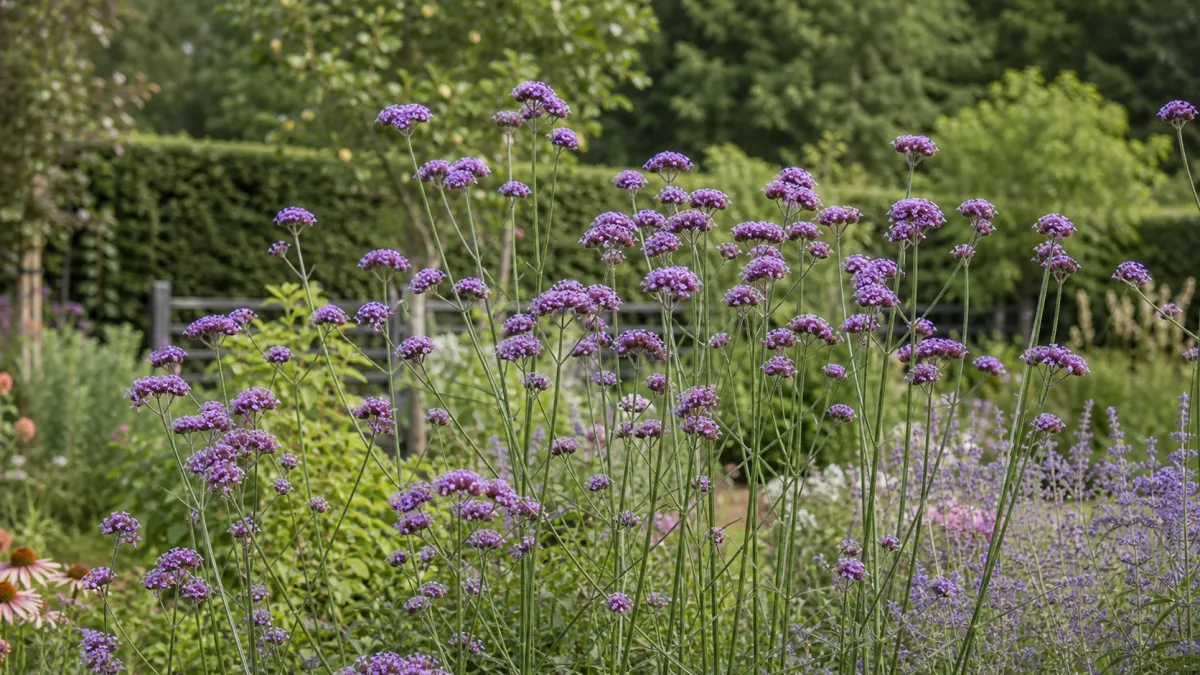
Tall verbena does not occupy a border like a hedge. Verbena bonariensis lifts small flower clusters on narrow, widely spaced stems, allowing lower plants and the view beyond to remain visible. That transparency is its design advantage and its structural challenge: an exposed stem still catches wind, and a crowded crown can disappear beneath vigorous neighbors. Place the plant by sightline, drainage and access before thinking about flower combinations.
Place tall verbena as a transparent border layer: test the sightline at mature height
Verbena bonariensis can reach about 1.5–2.5 meters (5–8 feet), placing small purple flower clusters on tall, open stems so it can rise through lower planting without forming a solid screen. Mark the intended crowns on a photograph of the border and draw vertical lines upward. Keep important path junctions, windows and seating views legible between those lines.
Place a few plants with space between them rather than making a dense wall. The stems need room at ground level even though the upper silhouette appears light. Leave a route to inspect the crown, place support and remove damaged growth without pushing through every neighboring plant.
- Preserve the view between stems and flower heads.
- Keep the crown accessible from a path or stepping point.
- Avoid positions where a gate or regular foot traffic will strike the stems.
Pair sun with drainage
Give the plant full sun and well-drained soil; wet ground is a poor match for a species that needs free drainage. Observe the proposed area after sustained rain rather than judging it during a dry week. A low pocket that stays saturated should be corrected for the whole bed or assigned to a plant better adapted to those conditions.
Do not improve drainage by making a small isolated hole filled with loose material inside heavy soil. Water may collect at the boundary. Consider the wider bed profile, soil structure and runoff, and keep the crown at an appropriate level when planting.
Make outdoor exposure a transition
When plants are raised indoors, follow packet timing and harden them gradually before setting them outside. Begin with sheltered outdoor periods suited to the weather, then increase light, wind and time outside while monitoring leaves and moisture. Cold, strong sun and drying wind can arrive together even when the air temperature seems acceptable.
Pause the transition during severe conditions rather than treating hardening as a countdown. A compact plant that arrives in the bed with functioning roots has a better starting point than a tall soft seedling rushed outdoors to satisfy a date on the plan.
Move seedlings in stages
The seed packet and local conditions must provide the timing.
- Sow with the temperature, depth and light treatment stated for the named seed lot.
- Give emerging seedlings strong suitable light and enough air movement to produce compact growth.
- Before planting, harden the young plants gradually instead of moving them directly from shelter to an exposed border.
- After planting, check moisture at the roots and protect the small crown from accidental weeding or trampling.
Support from the base, not the flower head
Assess wind funnels between buildings, along fences and across open slopes, then watch how the stems respond before intervening. A less exposed position may be better than building a rigid framework around a plant whose open habit is part of its value.
Avoid tying all stems into one rigid bundle; that erases the open habit and concentrates movement at the tie. After storms, inspect the base for twisting or cracked stems. If the same plant is repeatedly damaged, reconsider the site and surrounding exposure rather than adding tighter ties.
Keep the crown out of the shade below
The flower heads may stand in sun while the plant's base is crowded by broad leaves. Check which neighbors expand late and whether they block light, air or watering at the crown. Use lower plants with a manageable spread beside access points, and edit aggressive growth before it mats around the verbena.
Repeat the open upper silhouette through a border, but adjust the neighboring plants to each patch of soil and exposure. The pattern only works when every crown remains reachable and receives suitable conditions at ground level.
Choose what remains after flowering
Spent stems can retain structure, but damaged stems beside a path may become an obstruction. Decide selectively what to leave based on safety, appearance and local winter conditions. Do not count on plants or seedlings returning; survival and self-sowing vary with climate, soil, seed ripening and subsequent cultivation.
Verbena bonariensis has naturalized and behaved as a weed in some regions, so check local invasive-species lists and planting restrictions before allowing seed to mature. Where local authorities discourage or restrict it, choose another plant and prevent garden seedlings from reaching natural areas.
Tall verbena placement questions
Will tall verbena block plants behind it?
Its upper growth is open rather than solid, so lower planting can remain visible between stems. Position crowns deliberately and avoid a dense row. A photograph with proposed vertical lines is a useful sightline test before planting.
Does Verbena bonariensis need staking?
Not automatically. Inspect wind funnels and the plant's actual lean first. If stems repeatedly crack or twist, a less exposed site may be better; do not pull the whole plant into a tight bundle.
Can I plant it in wet ground?
Persistently wet ground is unsuitable for a plant that needs free drainage. Observe the area after prolonged rain and improve the broader bed or choose another species; a loose pocket inside heavy wet soil may simply collect water.
Will it return every year?
Do not rely on that outcome without local evidence. Winter survival and seedlings vary by climate, drainage, seed ripening and cultivation. Record what happens in the actual border and keep only volunteers that fit the plan.
Could tall verbena be invasive where I live?
Its status varies by region. Check the current local invasive-species or noxious-weed list before planting and before letting seed ripen. If local guidance restricts or discourages it, choose another airy border plant and remove volunteers before they spread.
Keep the airy outline without ignoring wind
Give Verbena bonariensis light, drainage and room for its airy stems, support only where exposure demands it and treat self-sown seedlings as a choice rather than an automatic benefit.