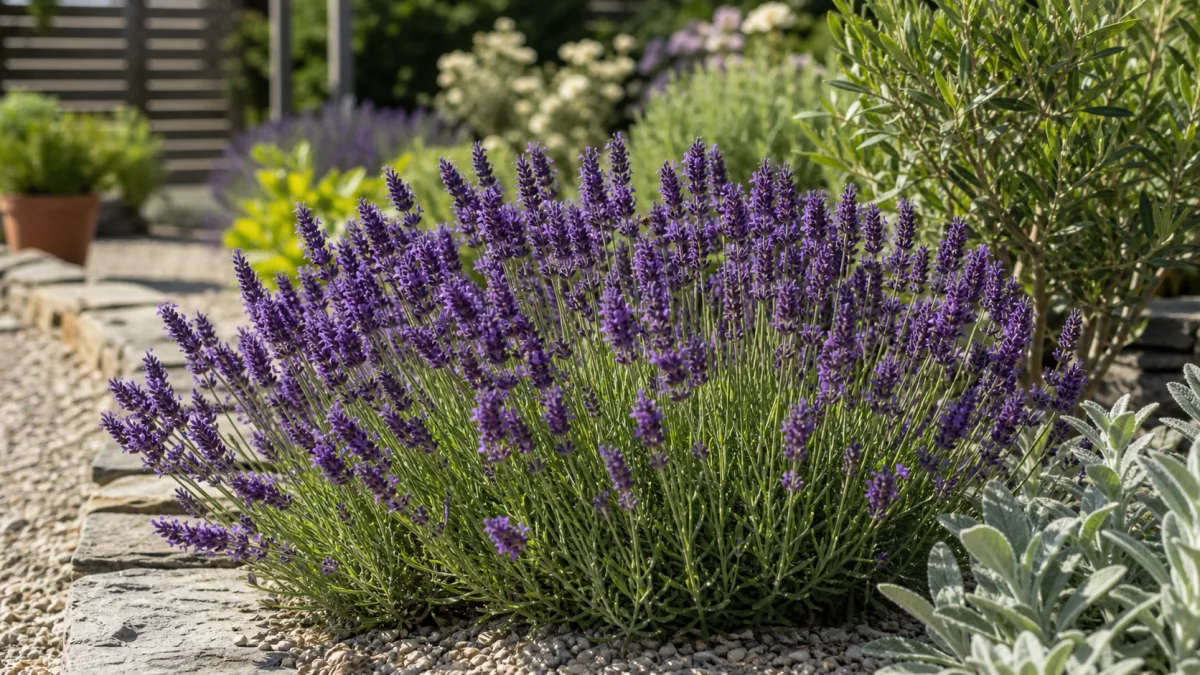
English lavender (Lavandula angustifolia) is adapted to bright, open ground that sheds winter rain. Plant it in lean, free-draining soil, water while new roots establish, then let the root zone lose some moisture between waterings. After flowering, shorten spent stems while green leaves remain below every cut: bare old wood may not produce replacement shoots.
Use English lavender where fragrance can be reached
Lavandula angustifolia forms an aromatic framework around 30–60 cm high, with summer flower spikes above narrow grey-green leaves. Violet and blue-violet are familiar, but named cultivars may flower pink or white. Put the plant beside a sunny path, at the front of a dry border or in a pot where brushing the foliage releases its scent without forcing feet into the crown.
The evergreen-looking base becomes woody with age. Leave enough space for light and moving air to reach it once neighbouring plants expand; a lavender squeezed behind lush perennials can lose its compact outline even when the top still receives sun.
A drainage test is more useful than a label on a bag of compost: water the prepared position, then check whether the root zone clears promptly instead of remaining cold and saturated. In a container, lift the pot feet clear of blocked drainage holes and remove the saucer before prolonged rain.
Judge the position after prolonged rain
Full sun is only half the site test. Inspect the ground after a wet spell: if water remains around the proposed root zone after the rest of the bed has drained, use a raised position, a more mineral growing medium or a container with unobstructed drainage holes. Do not create a rich pocket of moisture-holding compost inside otherwise open soil.
Spring planting gives roots time to occupy warming soil before the next wet winter. Set the plant at the same depth it grew in its pot and keep mulch away from the woody crown. Space plants by the named cultivar's expected spread rather than the size of the young nursery plant.
- Border: choose the brightest place that drains without leaving a wet hollow.
- Container: confirm that water can leave both the pot and any decorative outer container.
- Path edge: preserve enough width to prune without stepping on the crown.
Establish the roots, then keep the framework compact
Water newly planted lavender at the soil until roots establish. Later, check beneath the surface before watering: a pale dry crust on a sunny afternoon does not prove the whole root ball is dry, while a pot standing in collected rain remains at risk even when its leaves look grey and drought-adapted.
Once the main flower flush finishes, remove spent stems and a small amount of the current green growth. Keep living leaves below the cut. An old plant that has opened in the centre may not recover from being cut entirely into leafless wood; replacement is often more reliable than a severe rescue prune.
When the outline thins, inspect the base before changing the watering routine. A shaded plant may stretch towards the light, while a crown surrounded by persistently wet compost needs drainage corrected rather than another feed. In a pot, clear blocked holes and empty collected rainwater; in a border, pull mulch back from the woody stems. These checks address the conditions English lavender actually resents without treating every open or woody centre as thirst.
Lavender: FAQ
Can lavender grow in heavy soil?
Only where the root zone can be made reliably free-draining. Test the position after prolonged rain; a raised bed or container is safer than a single amended hole that collects water inside heavy ground.
How often should established lavender be watered?
Use the moisture below the surface rather than a fixed interval. Water new plants while roots establish; later, let free-draining soil lose some moisture and never leave a container standing in collected water.
How far back can lavender be pruned?
After flowering, shorten the spent stems and lightly shape green growth, leaving living leaves below each cut. A uniformly hard cut into bare old wood may not regrow.
What observation should guide the next step with Lavender?
Use the plant's actual growth, moisture at root depth and the forecast rather than a fixed calendar. For Lavender, that check separates timely care from an unnecessary intervention.
Drainage protects lavender more reliably than extra feeding
Lavender lasts when sun, drainage and restrained pruning work together; correct winter wet before adding feed, and keep green growth below every shaping cut.