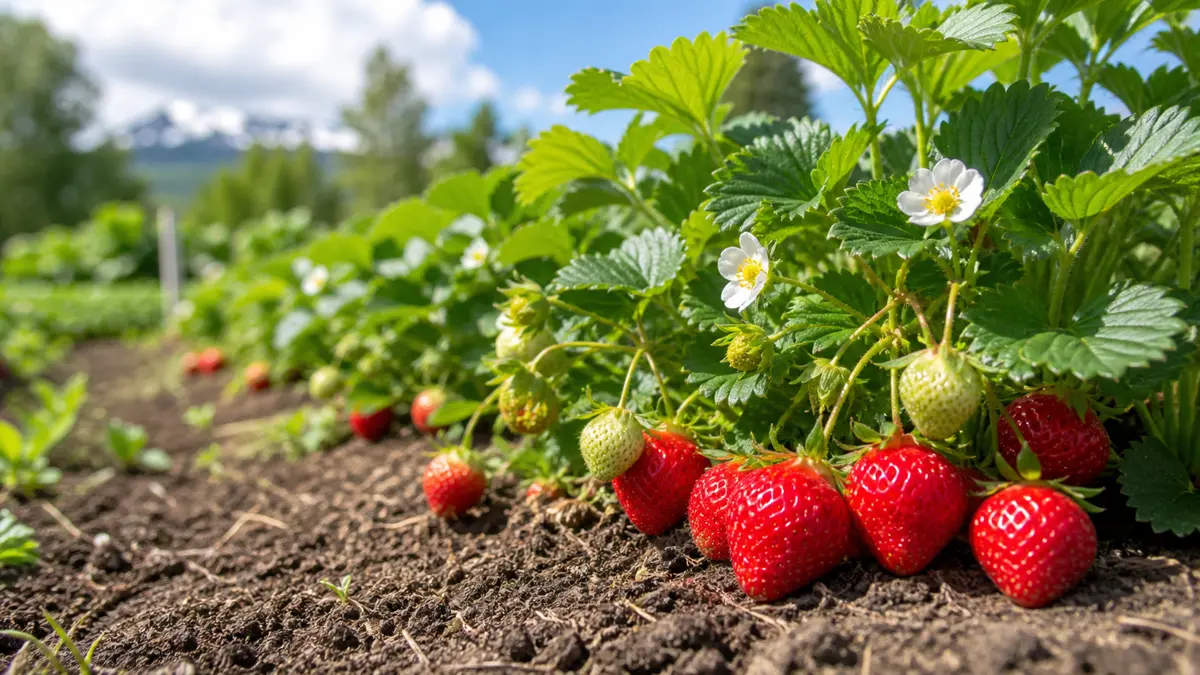
Begin with the fruiting type, not the calendar. An established summer-fruiting row may be cut back immediately after its main crop, but first-year, everbearing and day-neutral plants need their healthy foliage. Once autumn growth slows, the priorities change to moisture around the shallow roots, an uncovered crown and winter protection only where cold exposure calls for it.
First identify the plants you are tending
The final picking does not mark the start of one long tidy-up. Established summer-fruiting rows can be cut back and thinned as soon as the main crop is over. The plants then need time to replace their leaves, strengthen their roots, store energy and form next season's flower buds.
Once the weather turns cold, the priorities change. Healthy foliage stays, the crown remains clear at soil level, and the shallow root zone should be neither dry nor waterlogged. Winter cover comes later, after growth has stopped.
- Is the main crop over and the summer-fruiting row mature and crowded? This is the window for cutting back and thinning.
- Are the plants still actively growing? Keep healthy leaves, clear weeds and check the shallow root zone for dryness.
- Has growth stopped? Only then decide whether cold exposure or unreliable snow justifies winter straw.
Cut back old leaves while the plants still have time to recover
Established strawberries that produce one main summer crop can be cut back as soon as the main harvest has ended. Leave about 5 cm above the crowns, remove the cut foliage and narrow rows that have spread too far. Keep only the runners needed for planned replacement plants.
Do not postpone this work until late autumn. First-year plants should keep their leaves. Everbearing and day-neutral strawberries that are still flowering or fruiting are better managed by removing individual dead, damaged or diseased leaves.
Water at soil level if the bed is dry. Fresh foliage and roots need time to establish while the soil is still warm, without burying the crowns or leaving them in saturated ground.
Water during dry spells and tie feeding to renovation
Strawberries have shallow roots. During a dry autumn, check below the surface and water at soil level when the root zone is dry. Stop once rain is keeping the soil evenly moist or the ground has frozen. The aim is evenly moist soil, not a permanently wet crown.
Flower buds for the following season begin to form during late summer and autumn. A bed that is parched, overcrowded or cut back too late therefore enters winter at a disadvantage.
For established summer-fruiting rows, any feeding belongs with post-harvest renovation and should follow the soil and the plants' growth. University of Minnesota also describes a needs-based split application four to six weeks later.
Tidy the bed without stripping it bare
Once fresh foliage has grown, leave healthy leaves in place. They continue photosynthesising while light and temperature allow and help shelter the crown as the plant moves into dormancy. Snip rather than tug because strawberry roots sit close to the surface.
Remove mouldy or rotten fruit, clearly diseased leaves, fully dead debris and weeds likely to set seed. Summer straw that is wet, compacted or littered with old fruit should also go. Winter cover should be clean and airy, not the damp remains of the fruiting season.
- Keep the crown visible at soil level.
- Snip diseased leaves with clean secateurs or scissors.
- Weed before winter cover hides the row.
- Spread compost between plants, never over the crown.
Wait for dormancy before adding winter cover
In cold or snow-poor regions, apply winter straw after growth has stopped and soil temperatures have remained near 4–5 °C for several days. Dull or reddish foliage and a run of cold nights are more useful signs than a date on the calendar.
Covering too early can keep the plants warm and delay hardening. Do not wait until the bed is deeply frozen or buried under lasting snow, either. Judge the conditions in the bed itself.
For an exposed dormant bed, 8–12 cm of clean, loose straw is a practical starting point. In mild, wet winters, free drainage and airflow matter more than a thick layer. Whole leaves are a poor substitute because they readily mat together.
- Bare frost or unreliable snow: use clean, loose straw.
- Mild, wet winter: keep the layer light and check drainage.
- Windy site: keep the loose straw in place without compressing it.
Raised beds and pots need extra protection
A raised bed loses heat through both its top and sides. Make sure water can drain freely, use a slightly deeper airy layer than on an in-ground bed, and secure the straw against wind. Water only when the soil is actually dry.
Small pots, hanging baskets and narrow troughs can freeze through from every direction. Move them to a cold, unheated shed or garage where the plants can remain dormant; leaving small containers outdoors carries a high risk of winter damage.
Keep the compost just moist through winter. A warm living room is unsuitable because heat may restart growth long before the light is strong enough.
A practical sequence from harvest to spring
- Immediately after the main crop: cut back and thin established summer-fruiting rows if needed, remove unwanted runners and water in dry weather.
- Late summer and early autumn: let fresh leaves develop, keep weeds down and monitor soil moisture.
- Mid-autumn: remove rotten fruit, clearly diseased leaves and wet summer straw, but keep healthy foliage.
- Late autumn: add an airy winter cover once the plants are dormant and the site needs protection.
- Spring: move straw gradually away from the crowns as new leaves appear, keeping some nearby in case of late frost.
Where autumn care commonly goes wrong
Winter damage usually has more than one cause. These mistakes increase the risk of drought, rot or cold injury.
- cutting every plant down in late autumn without checking its age or fruiting type
- burying actively growing plants under a thick insulating layer
- letting the shallow root zone dry completely before bare frost
- feeding without relating the timing and amount to renovation and plant need
- letting whole leaves mat around the crowns
- leaving small containers unprotected on an exposed balcony or stand
Decisions to make before winter
Should strawberry plants be cut down in autumn?
Not as a routine late-autumn job. Established summer-fruiting rows may be cut back and thinned immediately after the main harvest, while there is still time to grow fresh leaves. First-year, everbearing and day-neutral plants should not be treated in the same way.
When should strawberries be covered with straw?
In cold-winter regions, wait until growth has stopped and the plants are dormant. Several cold nights and soil temperatures holding near 4–5 °C are better guides than a fixed date. Covering too early can delay hardening.
How much straw should I use?
For a dormant bed exposed to bare frost or unreliable snow, 8–12 cm of clean, loose straw is a useful starting point. Use a lighter layer in mild, wet districts and give raised beds more protection than beds at ground level.
Can fallen leaves be used as winter mulch?
Whole leaves are unsuitable as winter cover because they readily mat together. Clean, loose straw is the documented starting point in the cited guidance.
How do strawberry plants survive winter in pots?
Move the pot to a cold, unheated shed or garage where the plant can remain dormant. Keep the compost barely moist rather than wet or bone dry, and do not bring it into a warm room.
Should strawberries be fed before winter?
Feed established summer-fruiting rows, if needed, as part of post-harvest renovation. Match the amount to the soil and plant growth; a needs-based application may be split with a second assessment four to six weeks later.