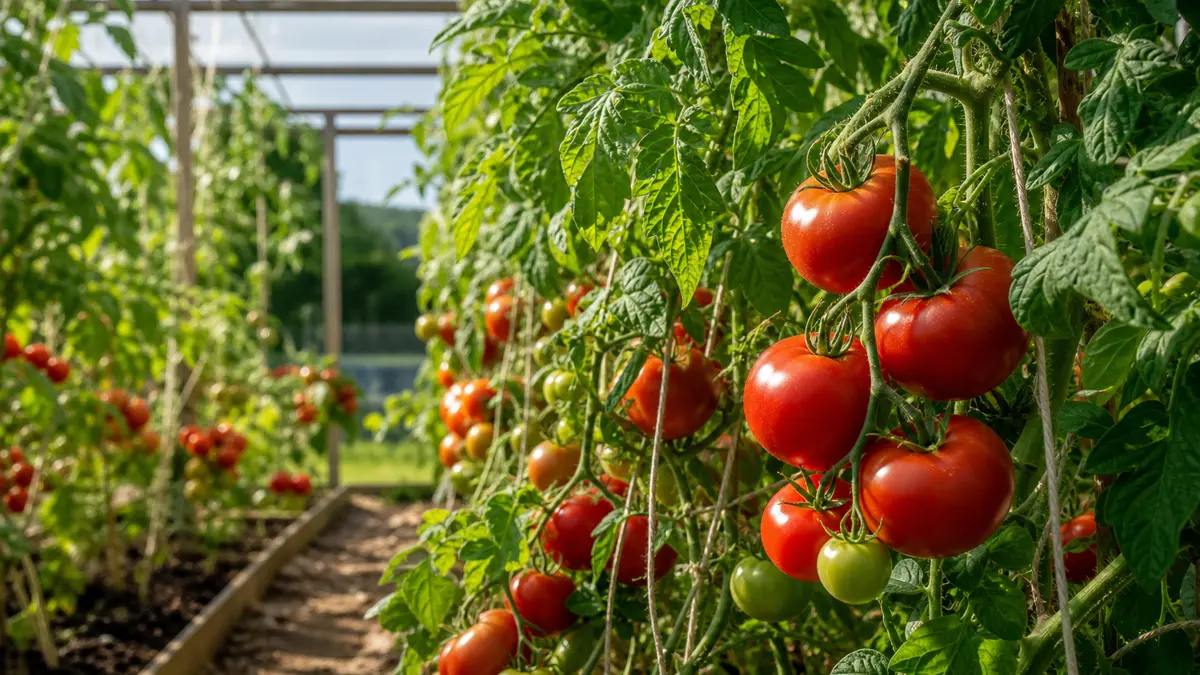
Before pinching anything, identify both the plant type and the structure in your hand. On a supported cordon or indeterminate tomato, a sucker grows from the leaf axil—the angle between a leaf stalk and the main stem—and may be removed to maintain the chosen framework. Flower trusses, fruit trusses and the main growing point are different structures. Bush, determinate, dwarf and trailing tomatoes retain their natural branching, so they should not be pruned by the same rule.
First identify the leaf axil, truss and leader
Start at the main stem and follow one leaf stalk outward. The sucker is the new leafy shoot tucked into that junction. A flower truss carries buds, flowers or developing fruit; the main growing point continues the leader upward. Pause whenever the structure is unclear. Waiting for another day is less damaging than removing the leader or a productive truss.
Cordon tomatoes are trained on a support with selected side shoots removed, while bush tomatoes retain their branching framework; in both types, keep every healthy flower or fruit truss. Check the seed packet, plant label or cultivar description for growth habit before adopting any pruning routine.
- Cordon or indeterminate: select the leader or leaders, provide support and remove only the side shoots that conflict with that framework.
- Bush or determinate: retain the cultivar's branching habit rather than applying a cordon routine.
- Unknown growth habit: keep the shoot until the label or cultivar description settles the question.
Confirm the tomato's growth habit before pinching
Decide why pruning is needed. On a supported indeterminate plant, moderate weekly removal can keep the framework manageable and make it easier to tie the main stem, inspect leaves and reach ripening fruit. It is not a cure for poor spacing, weak support or uneven watering, and stripping too much foliage removes useful leaf area.
Wait for dry foliage, keep pruning tools clean, and remove only small suckers that you can identify confidently. Larger cuts deserve extra caution because the wound is wider and the branch may already carry flowers.
- Confirm the cultivar is indeterminate before adopting a cordon-pruning routine.
- Trace the leaf axil and distinguish leafy growth from a flower truss.
- Check that the retained leader is securely tied to its support.
- Choose a dry working period and use clean hands or tools.
Inspect cordon plants little and often
A sucker is leafy growth from a leaf axil. Inspect supported indeterminate plants often enough to catch shoots while they are still easy to identify, and tie the retained leader as it grows. Move from the base upward and locate the main stem, leaf, sucker and any flower truss before acting.
Skip the job during rain, while leaves are wet with dew, or when the plant is stressed and the structure is difficult to read. Resume in dry conditions. As fruit develops, continue moderate management rather than trying to correct weeks of growth in one severe session.
A practical sequence through active growth
- At planting: record the cultivar's growth habit and install the support before the stem leans.
- During active growth: trace each leaf axil on the retained leader and leave any uncertain structure for another look.
- After removing a small side shoot: retie the leader and check nearby flower and fruit trusses.
- Later in the season: let remaining time, support and existing fruit guide whether another cut is worthwhile.
Retie the leader and check every fruiting truss
After pruning, check that the main leader is securely supported without a tie cutting into the stem. Look again for flower trusses hidden behind foliage and confirm that no fruiting branch was damaged. Remove cut material from the working area so it is not confused with harvested produce.
Keep watering consistent with the crop's needs rather than responding to pruning with extra water or feed. At the next weekly inspection, look at the previous wounds and the plant's overall growth. If the canopy is already open and manageable, leaving a small sucker for another visit may be better than removing growth simply because it exists.
- Recheck ties after wind or after a fruit truss becomes heavier.
- Leave a side shoot when removing it would create a large wound for little gain in access.
- Keep pruned stems and suspect plant material separate from produce for the kitchen.
Four pruning errors that cost leaves or fruit
The most consequential mistake is misidentification: a healthy flower truss or the main growing point cannot be replaced by calling it a sucker afterward. Slow down at crowded stem junctions.
- Removing branching from a bush, dwarf or trailing cultivar that should retain it.
- Mistaking the main growing point or a flower truss for a sucker.
- Making large corrective cuts in wet foliage after inspections were skipped.
- Stripping healthy leaves when moderate training would keep the supported plant manageable.
Use one plant to learn the stem pattern
Use one plant as the reference before moving along a row. Confirm its growth habit, locate the supported leader and trace each leaf axil. This repeatable sequence is more reliable than pinching every shoot that points sideways.
- Check every leaf junction on the retained leader in the same order.
- Leave any structure that cannot be identified confidently until the next inspection.
- Finish by checking ties, flower trusses and developing fruit for accidental damage.
Questions about tomato side shoots
How can I tell a tomato sucker from a flower truss?
First confirm the cultivar is indeterminate or cordon, then identify the sucker as leafy growth from the joint between a leaf and the main stem. Keep flower trusses and the main growing point.
Should I remove suckers from every tomato plant?
No. Routine side-shoot removal is mainly used when training cordon or indeterminate tomatoes on a support. Bush, dwarf and trailing types depend on branching growth, so check the cultivar description before cutting.
When is a sucker easiest to remove?
Check during active growth and work when foliage is dry. A small, clearly identified leaf-axil shoot is easier to pinch cleanly than an older branch; leave it until another visit if its identity is uncertain.
What should I check immediately after pruning?
Make sure the retained leader is tied without constriction, then inspect the nearby flower and fruit trusses for accidental damage. Keep cut stems separate from tomatoes going to the kitchen.
Trace a crowded shoot back to its point of origin
Near the top of the plant, young leaves, the leader and flower trusses may be crowded together. Hold the nearest leaf aside and trace the shoot back to its junction: a sucker starts in the leaf axil, while the leader continues the main stem and a flower truss carries buds. Leave the structure in place if its origin is still unclear.
Keep pruning separate from harvest hygiene
Wash hands before handling harvested tomatoes. Rinse fresh produce under running water before eating and do not use soap or produce wash. Discard rotten produce, and keep fruit that is ready for the kitchen away from discarded stems and leaves while you work.
Pruning decisions and harvest decisions happen on the same plant but answer different questions. A leaf-axil shoot may be removed to manage an indeterminate framework; a sound fruit is harvested as its colour begins to change. Never remove a healthy fruiting truss while searching for side shoots.