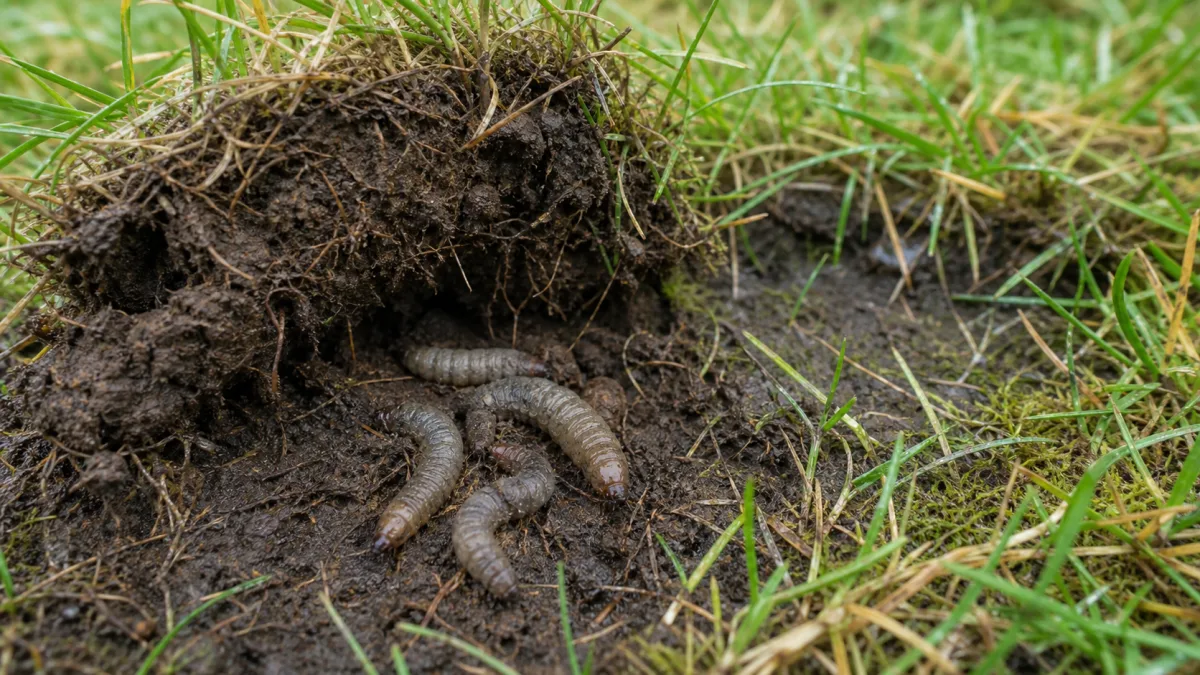
Leatherjackets are grey-brown, legless crane-fly larvae that live close to the soil surface and can loosen turf by chewing its roots. Yellowing and bird probing are clues, not a diagnosis: drought, compaction and fungal disease can weaken the same patch, while white, curved chafer grubs have a distinct brown head and legs. Lift a small flap where green turf meets fresh damage and make the diagnosis from the larva, the roots and the soil together.
Read the boundary between sound and failing turf
An old bare centre often contains little evidence: roots have already died, soil has dried and predators may have removed larvae. The useful inspection point is the boundary where grass is newly yellowing or pulls away too easily. Cut three sides of a square, fold the turf back without shredding it and examine the upper soil in good light.
Look for tough-skinned larvae without legs or a distinct head capsule. Record how many appear in a measured area and whether white roots remain. A single larva beside healthy roots is a different problem from repeated finds beneath several weak patches.
- Compare at least two damaged edges with one apparently healthy patch.
- Photograph the larva beside a scale if identification is uncertain.
- Replace and water the inspection flap so the diagnosis does not create another bare spot.
Separate the larva from its adult crane fly
Adult crane flies do not feed on turf roots. Their appearance shows that egg laying is possible, but it neither locates larvae nor proves that numbers are high enough to thin a lawn. Avoid treating an entire garden merely because adults rest on windows or move through long grass.
Young lawns, seedbeds and newly transplanted plants deserve closer attention because a small root system has less capacity to absorb feeding damage. Established turf may tolerate some larvae when roots are dense and the soil is not waterlogged.
Follow the soil, not a borrowed month
Eggs and larvae develop differently with species, rainfall and temperature. Damp turf may keep larvae near the surface, while dry or cold conditions change their position and activity. Use repeated inspection of the same marked patches instead of assuming that a control window from another region applies unchanged.
Repair the lawn while monitoring the cause
Rake away dead material only after the turf edge stops retreating. Relieve compaction where it is real, restore drainage rather than adding daily surface water, and reseed when seedlings can root before the next stressful period. Keep the seedbed evenly moist without leaving it saturated.
Mark two reference squares. New rooting, firmer turf and reduced expansion of damage are better recovery measures than comparing colour with an unrelated part of the lawn.
Put any biological control behind a current label check
A general English guide cannot establish whether a nematode product is authorised or available where you live. Before considering one, check the current national regulator and the current label for the target, site, user class and soil conditions; if those details do not match, stay with repair and monitoring.
A supplier's calendar is not a universal treatment window. Larval stage, soil moisture and temperature still matter, but the binding instructions come from the current local label rather than a date borrowed from another country.
A leatherjacket investigation in four visits
- First visit: mark the active margins, photograph symptoms and inspect turf, roots and upper soil.
- Second visit: compare larval finds in damaged and healthy reference squares after similar weather.
- Decision visit: check whether turf recovery is enough; if not, consult the current regulator and label before considering a biological control.
- Recovery visit: record new roots and patch expansion before reseeding gaps or repeating any intervention.
Practical questions about leatherjacket larvae
How do I distinguish leatherjackets from chafer grubs?
Leatherjackets are grey-brown and legless, without the white curved body and obvious brown head of a chafer grub. Use a reliable identification reference when the specimen is damaged or very small.
Do many crane flies mean the lawn must be treated?
No. Adult activity shows an opportunity for eggs, not the number of larvae beneath a specific patch. Inspect the root zone before deciding that treatment is justified.
Why are birds pulling at the same patch?
Birds may be finding larvae near the surface, but feeding damage can enlarge a weak area. Their activity directs an inspection; it does not replace one.
Can I sow grass immediately after finding larvae?
Reseed once the cause is controlled or declining and conditions suit germination. Seed scattered into actively loosening, saturated turf is likely to fail before it forms a resilient root system.
Judge the repair by new roots and turf recovery
Keep the original inspection squares marked until new roots hold the turf and the damaged boundary stops moving. That evidence tells you whether the lawn needs reseeding, another diagnosis or no further intervention.
Confirm larvae beside fresh root damage before acting
Leatherjackets are crane-fly larvae, and a dense population can chew lawn roots as well as the roots of young plants.
Inspect damp turf at the moving edge of root feeding, where shallow larvae remain near the surface beside newly weakened grass.
Confirm larvae before treating, then improve thin turf conditions so replacement roots have light, air and appropriate moisture.