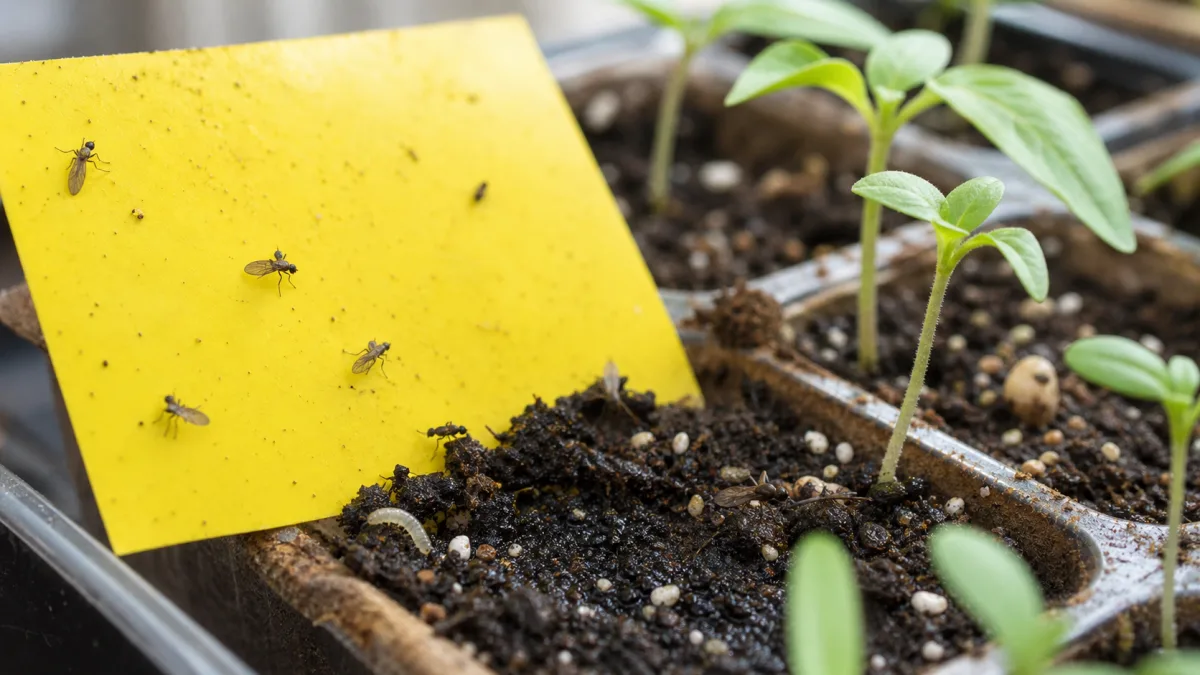
Fungus gnats are tiny dark flies around seedlings, but the vulnerable roots below the surface are the real concern. Check the moist compost for translucent larvae, remove decaying plant material and change the watering routine without letting young plants wilt.
How to control Fungus gnats in pots and seed trays: confirm fungus gnats before acting
Adults are small, dark flies that run across pot rims or gather near seedlings. Their pale larvae live in moist organic compost and may damage fine roots, particularly in seed trays and cuttings.
Yellow sticky cards reveal adult activity but do not remove larvae from the compost. Lift a small sample of the damp surface layer and look for slender translucent larvae with dark heads.
Keep a dated note of adult catches, larval checks and each watering change for two or three weeks. A falling trap count is useful only when fresh inspection also finds fewer larvae and seedlings remain firm. If one tray stays wetter than the others, isolate its drainage or compost problem instead of changing the routine for every pot.
- Weak or stalled seedlings
- Adults on yellow cards or pot rims
- Larvae in consistently damp compost
Why wet compost favours an outbreak
Constant surface moisture, algae and dead leaves provide favourable conditions for fungus gnats. Seed trays, houseplants and protected growing spaces are especially exposed during cool periods when compost dries slowly.
A practical control sequence
First remove dead material and improve drainage. Then let the surface dry slightly between waterings while checking that the root ball of a young seedling does not dry out completely.
Treat trays separately when their compost, pot depth or root development differs. A newly pricked-out seedling can lose water much faster than an established houseplant, so use pot weight and a finger check below the surface rather than imposing one dry interval on the entire shelf.
If larvae remain after the moisture correction, identify where adults can still lay eggs: an algae-covered capillary mat, standing water in a cover pot or an unopened bag of persistently wet mix can keep the cycle going. Cleaning the visible tray while leaving that reservoir untouched produces a quick rebound.
- Reduce unnecessary watering
- Remove algae, moss and fallen leaves
- Use traps to monitor adults
What to do over the next few weeks
- Day 1: inspect compost and remove decaying material.
- Week 1: adjust watering and monitor yellow cards.
- Week 2: check whether adult numbers and larvae are declining.
- Later: use an approved larval treatment only if cultural control is insufficient.
Water seedlings without feeding the problem
Water from below when appropriate and empty surplus water after the compost has absorbed what it needs. Better spacing and ventilation help the surface dry without subjecting seedlings to severe drought.
Mistakes that prolong fungus gnats
Spraying visible adults alone leaves the larval stage untouched. Repeated heavy watering also undermines control, even when yellow cards are catching many flies.
- Do not keep seed compost permanently saturated
- Do not rely on traps as the only measure
When biological controls make sense
Bti products or suitable nematodes may target larvae when they are approved for the intended use. Follow the current label because permitted uses, temperature limits and application instructions differ by product and country.
Questions about Fungus gnats
Are fungus gnats harmful to people?
Fungus gnats around pots are a plant and nuisance problem, not a biting pest. Their larvae matter most where young roots are delicate.
Can I simply stop watering?
No. Seedlings still need moisture around their roots. Aim to let only the surface dry slightly and judge each tray or pot by its actual water need.
Do yellow sticky traps solve the infestation?
They catch adults and show whether activity is changing, but larvae remain in the compost. Traps work best alongside drainage, hygiene and improved watering.
When should I use nematodes or Bti?
Consider a product labelled for fungus gnat larvae when non-chemical measures are not enough. Check approval, temperature and application instructions before use.