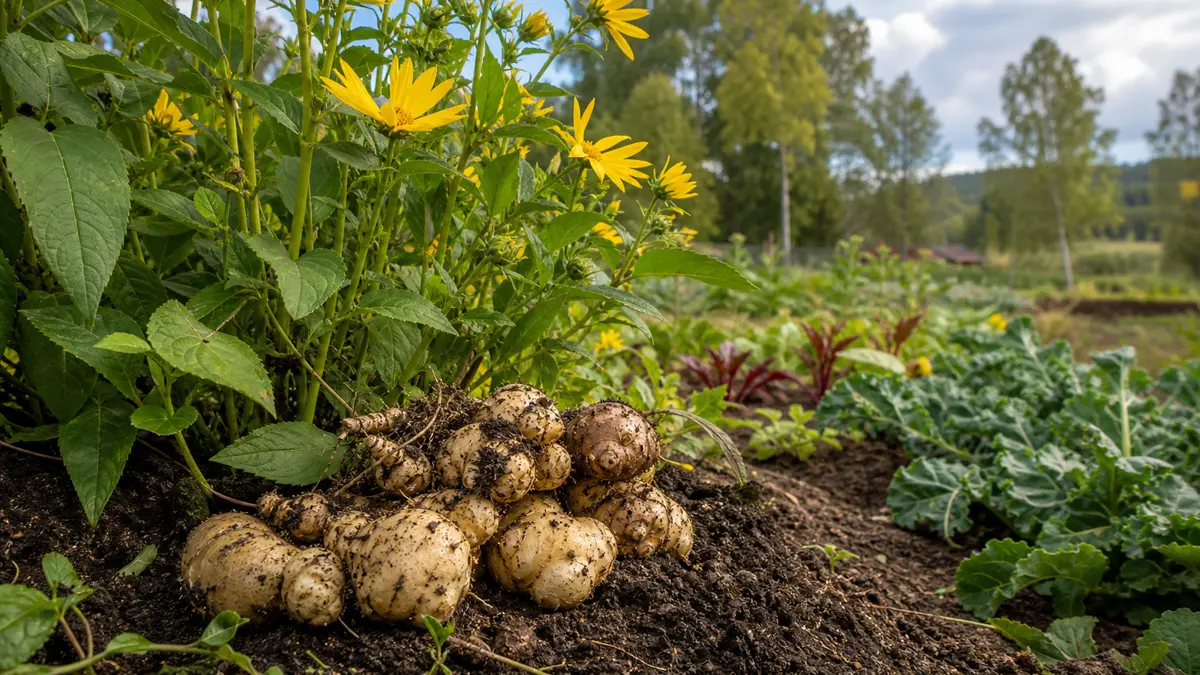
Jerusalem artichoke (Helianthus tuberosus) is a sunflower relative grown for edible underground tubers; its yellow-flowered stems can reach roughly 150-250 cm. Plant it where those stems can be supported and where every side of the patch remains accessible at harvest, because a small tuber left behind can restart the crop.
The harvest grows below a very tall plant
The crop's persistence comes from tubers left in the soil, so containment and complete lifting matter when you want to limit its spread. A freestanding patch is easier to dig cleanly than tubers threaded among permanent roots.
The tubers contain inulin and are harvested as a vegetable; that composition is a crop characteristic, not a reason to make medical claims about eating them.
- Edible tubers form below ground.
- Yellow flowers appear on tall sunflower-like stems.
- A mature height around 150-250 cm calls for space and wind support.
Choose a boundary before the first tuber goes in
Choose a position where stems up to 150-250 cm will not shade lower crops and where wind support will not obstruct the path.
- Keep the patch away from roots you do not want to disturb at harvest.
- Leave working room for a fork along every edge.
- Provide support before summer wind leans the mature stems.
- Mark the boundary while the stems are visible so winter digging stays inside it.
Plant selected tubers into a patch you can dig completely
Plant sound seed tubers in workable soil and mark the outer row. As shoots rise, remove any that appear beyond the intended edge rather than allowing a second patch to establish unnoticed.
A wind-exposed stand benefits from stakes or a supporting line before the stems are fully elongated. Water during prolonged dry periods, especially while the plants are establishing and the tubers are swelling.
From spring shoots to winter lifting
- Spring: plant selected tubers and mark the harvest boundary.
- Summer: support the tall stems and remove shoots outside the patch.
- Late autumn: begin lifting once the top growth has declined.
- Winter: harvest in stages while the soil remains workable, reserving sound tubers for spring.
Support tall stems and keep the patch contained
Tie stems loosely enough to avoid cutting into them and keep the base visible so outlying shoots are easy to spot. The aim is not a tidy top at any cost; it is an upright canopy above a patch that remains reachable with a fork.
Do not dig repeatedly through dry soil searching for every tuber. Wait for workable conditions, lift methodically from one edge and replace the soil only after checking the hole.
Contain missed tubers and avoid a dry stored harvest
Lift only what you can use soon when the ground can serve as storage. Freshly dug tubers lose moisture in dry indoor air, so keep unwashed tubers cool and humid rather than leaving them exposed on a shelf.
- Do not compost unwanted live tubers where they can survive and spread.
- Do not mix seed tubers with the portion intended for the kitchen.
- Do not let the winter boundary disappear after cutting the stems.
- Do not store washed tubers uncovered until they become soft and shrivelled.
Keep tubers separate from permanent beds
Keep Jerusalem artichokes out of permanent asparagus, berry or perennial beds where complete lifting would damage neighbouring roots. A separate vegetable patch also makes it simpler to rotate the following crop after the last tubers are removed.
If a permanent in-ground patch is unsuitable, a large robust container can make the boundary obvious, although its smaller soil volume needs closer watering and winter protection than open ground.
Questions about height, harvest and containment
Why do Jerusalem artichokes spread after harvest?
Each tuber can produce new shoots. Small tubers missed at the edge or moved with soil can therefore establish plants outside the intended patch.
When should I lift Jerusalem artichoke tubers?
Lift tubers from late autumn after the top growth declines, and continue through mild winter whenever the soil is workable. Harvesting in stages keeps the remaining crop from drying in storage.
How should freshly lifted tubers be stored?
Brush off loose soil without washing the storage portion, then keep it cool and humid. Use damaged tubers first and reserve firm, healthy examples separately for replanting.
Can I replant tubers from my own harvest?
Yes. Set aside sound tubers from a productive, healthy patch, label them and replant in the marked area. Do not return every small tuber unless you want the stand to become denser.
A contained patch turns persistence into an advantage
Jerusalem artichoke is easiest to manage as a contained, clearly marked patch harvested in stages, with every stray tuber treated as a future plant rather than harmless waste.