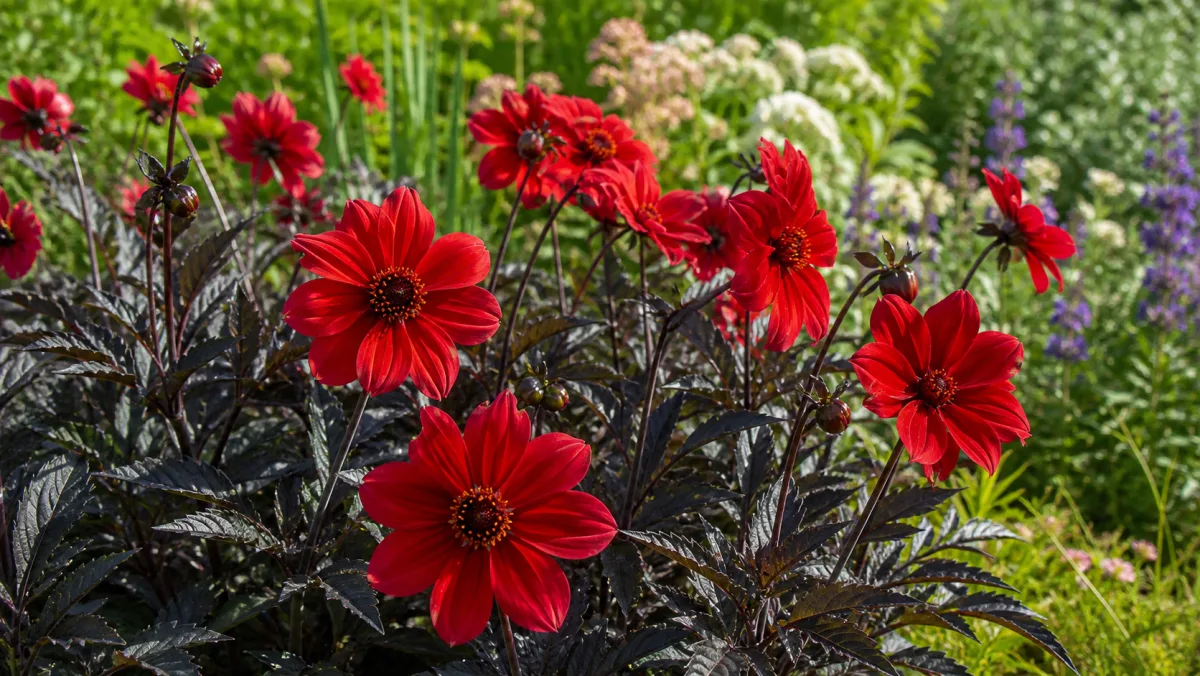
Dahlia 'Bishop of Llandaff' pairs scarlet-red flowers with dark bronze foliage on an 80-100 cm plant, so the leaves deserve as much visibility as the blooms. Use a sunny drained position, support the stems early and keep the base reachable for deadheading, watering and autumn tuber lifting.
Scarlet flowers carried above dark bronze foliage
'Bishop of Llandaff' is valued for scarlet-red flowers set against dark bronze foliage on a plant around 80-100 cm high. That contrast works best where the leaves can be seen from the front of a border rather than buried behind taller, dense planting.
Although shorter than several large-flowered dahlias, it still needs early support and access for deadheading. Plan its sunny drained position around the mature width, the stake and the autumn lifting route rather than squeezing the tuber into a temporary gap.
The display can continue from midsummer until frost under suitable conditions. Remove spent blooms, monitor moisture at the roots and stop treating the calendar as a promise when cold or saturated soil ends active growth.
- dahlia tuber.
- scarlet red against dark bronze foliage.
- 80-100 cm.
Choose sun and airflow that preserve the foliage contrast
Select a bright position where bronze foliage will not disappear against a dark backdrop. Drainage, a reachable water point and enough space to tie stems without crushing leaves are the practical checks.
Keep the plant accessible through autumn. Once frost ends the display, the labelled tuber must be lifted, dried and moved to cool frost-free storage without confusing it with neighbouring cultivars.
- full sun and airflow around the dark bronze foliage
- lighter or lower neighbours that leave the leaf colour visible
- discreet support for 80-100 cm stems without crushing the canopy
- an accessible crown for watering, deadheading and autumn lifting
Start warm, then move into settled outdoor conditions
A protected spring start is useful only when new growth has strong light and remains frost-free. Plant outside after local frost risk in a sunny bed with good air movement, keeping the crown level and reachable.
At 80-100 cm, 'Bishop of Llandaff' is shorter than the tallest cutting dahlias but still benefits from early support. Place the stake where it will not hide the dark foliage or obstruct later lifting.
A compact dahlia season from first shoots to lifting
- Spring: start the labelled tuber warm or wait until the outdoor bed is sheltered and warm.
- Early summer: settle the plant in full sun, set the support and water the whole root zone.
- Flowering months: remove spent scarlet blooms, retain airflow and inspect the bronze foliage for damage.
- After frost: lift, dry and label the tuber before cool frost-free storage.
Keep the dark canopy open and the stems supported
Water at soil level and keep neighbouring growth from pressing into the dark foliage. The contrast is clearest when air can move through the canopy and scarlet flowers are removed as they fade.
Check support after wind even though this cultivar is usually planned at 80-100 cm. A bent main stem can open the crown to damage, while an overwatered bed can weaken the tuber below an apparently full canopy.
Setbacks that dull foliage or shorten flowering
'Bishop of Llandaff' loses its strongest feature when cramped planting hides the bronze foliage or prevents air moving through it.
- placing the plant behind foliage that hides its dark leaves
- assuming an 80-100 cm dahlia never needs support
- keeping the root zone wet because the upper growth looks thirsty
- lifting without a durable label that survives winter storage
Use the bronze leaves as a contrast, not background filler
Use 'Bishop of Llandaff' where the bronze foliage can contrast with pale green leaves before the scarlet flowers open. It can sit nearer the middle of a border than a 130 cm dahlia, provided the lifting route remains clear.
Avoid pairing it with equally dark, dense neighbours that erase the outline of the plant. A lower, lighter companion makes the foliage readable and leaves room to inspect the crown.
Questions about Dahlia 'Bishop of Llandaff'
How can I make the dark foliage of 'Bishop of Llandaff' stand out?
Place it in full sun with lighter or lower foliage nearby, while keeping enough airflow around the plant. The bronze leaves should remain visible before and between the scarlet flowers.
Does an 80-100 cm plant still need support?
Usually yes, especially in an exposed bed or once rain weighs down the flowers. Add a discreet stake early so ties can follow the main stems without crushing the dark canopy.
When should I start or plant the tuber?
Start it warm under cover if you can provide strong light and frost protection, or wait until the outdoor soil is sheltered and warming. Do not move soft new growth outside merely because the calendar says spring.
What care is needed after the last flowers?
Once frost ends the display, lift the tuber, let it dry, attach a durable cultivar label and store it cool and frost-free. Keep stored tubers separate so the dark-leaved cultivar is identifiable next year.