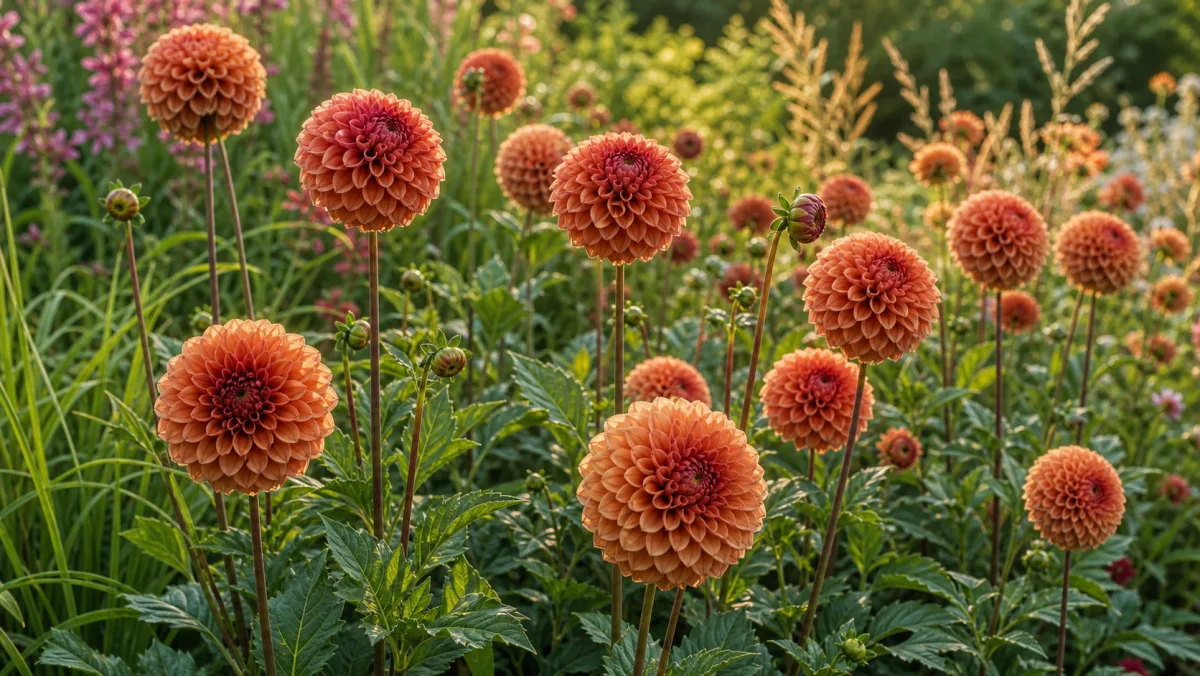
‘Cornel Brons’ is not defined by the brownish colour its name may suggest. Its registration describes a 75 mm miniature ball flower in vivid to strong orange, with yellow tones at the floret bases, on a stem recorded at 0.9 m. Treat those figures as an identity check and a guide to scale: the real garden work is giving the tuber sun, early support, accessible cutting stems and a labelled route into frost-free winter storage.
Dahlia 'Cornel Brons': the registered scale is the useful starting point
The international dahlia register places ‘Cornel Brons’ in group 6(b), the miniature ball class, and records flowers 75 mm wide. It also records a 0.9 m stem. These are observations supplied at registration, so use them to identify the cultivar and judge its likely proportions rather than as a guarantee that every plant will match them exactly.
A miniature ball flower is fully double, rounded and built from tightly arranged florets. At roughly 7.5 cm in the register, ‘Cornel Brons’ can repeat its shape across a border or sit comfortably among smaller cut flowers. The documented orange and yellow colouring is the cultivar record; warm light or a photograph may make those petals read as bronze, but that visual effect should not replace the registered description.
Place it where the rounded heads can be seen from the front or middle of a bed and where one side remains reachable with secateurs. A hidden plant may still flower, but cutting and deadheading through neighbouring stems soon becomes destructive.
Build support around the stem height, not the flower diameter
A plant near the registered stem height can become top-heavy once several wet flowers open. Put in a cane, ring or low grid while the shoots are short, keeping ties loose enough for stems to thicken. Support added after a storm usually has to force bent growth back through foliage.
Choose a warm, sunny position with fertile soil that drains after heavy rain. Dahlias need moisture while growing, yet a tuber sitting in airless, saturated ground is vulnerable to rot. In a container, that means a broad, stable pot, an open drainage hole and more frequent checks during hot weather.
Leave enough room to follow a flowering stem down to a leaf joint. Cutting there produces a useful stem and keeps the remaining framework tidier than repeatedly snipping just below each head.
- Install the support before the canopy hides the centre of the clump.
- Keep a narrow working edge for tying, cutting and inspecting stems.
- Label the plant before lifting; dormant tubers cannot be identified by flower form.
A season that ends with the correct tuber
- At the start of growth: inspect the crown for sound tissue, pot it in good light if starting early, and keep the compost only lightly moist until shoots are active.
- After frost risk: acclimatise the plant, set it in its prepared sunny position and fix the permanent label beside the crown.
- During flowering: tie new levels loosely, water the root zone in dry spells, cut fully open flowers and remove spent heads back to a leaf joint.
- Before freezing conditions: lift where local winter cold or wet makes outdoor survival unsafe, dry the surface, and store only healthy labelled tubers in a cool frost-free place.
Cut a stem that leaves the plant with somewhere to grow
For the vase, select a firm flower that has opened fully; dahlia buds cut tight do not finish like many other cut flowers. Trace the stem to a usable junction and make the cut where the remaining branches can continue the framework.
A faded head is more pointed than a rounded developing bud. Remove the spent flower with part of its stalk instead of leaving a row of short dead stubs. This small distinction matters on a ball dahlia because the dense canopy can otherwise become cluttered and difficult to inspect.
The 75 mm registration record is an identity measurement, not a target to force with extra feed or severe thinning. Note the typical flower size on your own labelled plant and judge it alongside stem strength, flower form and colour rather than rejecting a healthy bloom for missing one number.
Questions about ‘Cornel Brons’
What does the registered 75 mm measurement mean?
It is the recorded flower diameter, not a promise for every bloom. Weather, feeding and the number of stems can change the size produced in a particular garden.
Is ‘Cornel Brons’ a pompon dahlia?
No. The international register places it in miniature ball group 6(b). Ball flowers are fully double and rounded, while pompons form a separate, smaller classification.
When can a started plant go outside?
Move it out only after local frost risk has passed, and acclimatise indoor-grown shoots gradually. A fixed date cannot cover every climate or elevation.
How do I keep the cultivar correctly named over winter?
Attach the label while the plant is still flowering, lift if freezing or winter wet threatens the tuber, dry the surface and store the healthy clump in a cool, dark, frost-free place.
The cultivar name must survive the dormant season
Once foliage is damaged by frost, decide between in-ground protection and lifting according to the severity and wetness of the local winter. Leaving tubers outdoors is a calculated risk in mild, freely drained ground; lifting is the safer choice where soil freezes, stays wet or the cultivar is difficult to replace.
Let excess moisture drain from a lifted clump and remove obviously damaged tissue. Store it cool, dark and frost-free, then inspect occasionally for spreading rot or severe shrivelling. Divide in spring rather than cutting a damp clump into multiple fresh wounds before storage.
Keep the durable label attached to the clump or its box. That simple habit preserves the link between the sleeping tuber and the 75 mm miniature ball form you planned the border around.