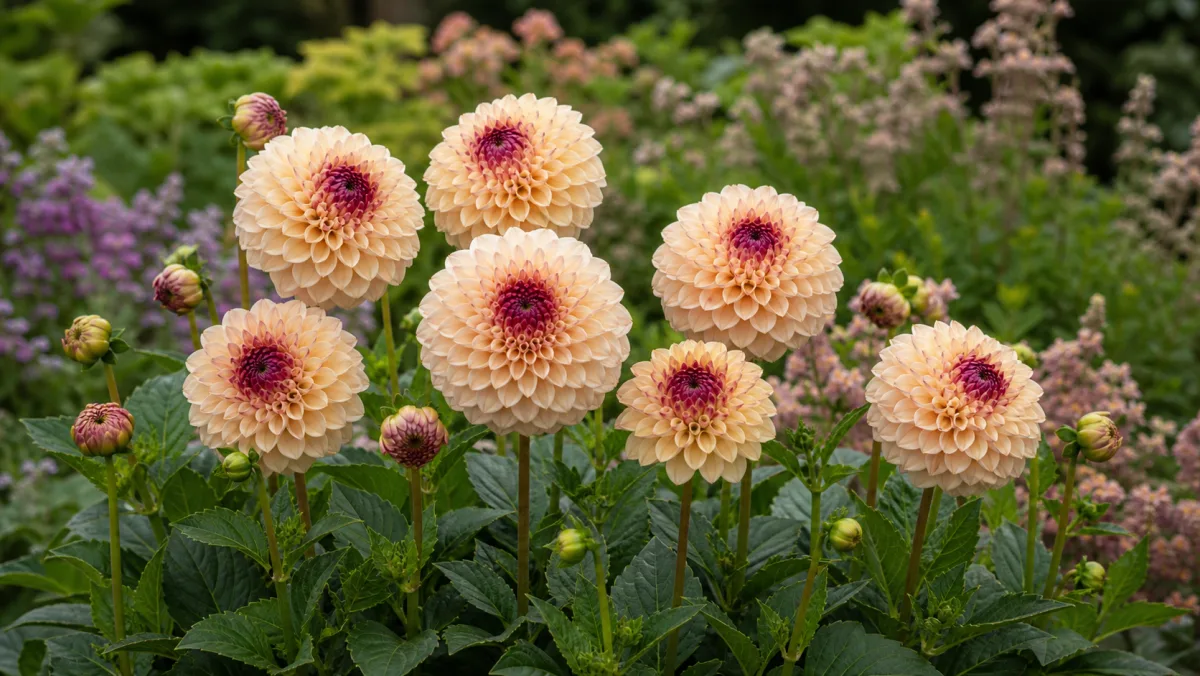
'Wine Eyed Jill' is identified by cream and apricot petals gathered around a wine-red centre on a plant expected around 70–90 cm. Place it close enough to see that central contrast, with a clear side for cutting and a label that stays with the tuber through winter.
Cream and apricot petals around a wine-red eye
Treat Dahlia 'Wine Eyed Jill' as a site decision, not just a plant profile. dahlia tuber, cream, apricot and wine-red centre and 70-90 cm set the practical limits for the bed, pot, support or harvest route.
The dark eye is a viewing detail rather than a reason to crowd the plant at a path edge. Give the stems sun, drainage and modest support, then use lower companions that repeat the cream or wine tones without concealing the flower centres.
Keep July to frost in view as a limit. If the site cannot deliver Cream, apricot and wine-red centre without crowding or weak stems, move Dahlia 'Wine Eyed Jill' before buying companions or adding equipment.
- dahlia tuber.
- cream, apricot and wine-red centre.
- 70-90 cm.
Place the flower centres within a clear sightline
Start with the place. Place Dahlia 'Wine Eyed Jill' where Dahlia tuber and Cream, apricot and wine-red centre can be seen without blocking access to the stake, cutting side or labelled crown.
Then compare the season with the work you can repeat. For Dahlia 'Wine Eyed Jill', concentrate on the constraint created by Cream, apricot and wine-red centre and record one adjustment after the season instead of applying a generic dahlia checklist.
- buying Dahlia 'Wine Eyed Jill' without space to display Cream, apricot and wine-red centre, accessible support and a labelled frost-free storage place
- following a printed date despite cold soil, saturated ground or wind that threatens Cream, apricot and wine-red centre on stems of 70-90 Cm
- placing Dahlia 'Wine Eyed Jill' where Cream, apricot and wine-red centre cannot be reached for tying, cutting or autumn lifting
- ending the season without recording how Cream, apricot and wine-red centre performed or keeping the cultivar label with the tuber
Support medium stems without hiding the dark centres
Before planting Dahlia 'Wine Eyed Jill', prepare drainage, a stake, a working path and a label that will remain with Cream, apricot and wine-red centre through lifting and storage. Make corrections while the shoots are short; once Cream, apricot and wine-red centre is carried on growth of 70-90 Cm, moving ties or reaching the crown becomes riskier.
Use the calendar only as a guide. Wait for warm soil and the end of damaging frost before planting Dahlia 'Wine Eyed Jill'; later, use root-zone moisture and the load created by Cream, apricot and wine-red centre rather than a fixed calendar to time care.
A viewing-and-cutting calendar for 'Wine Eyed Jill'
- Tuber, support and winter storage.
- Dahlia tuber.
- Cream, apricot and wine-red centre.
- 70-90 Cm.
Remove faded heads before they muddy the two-tone display
Check moisture beneath the surface and turn the plant gently when inspecting ties so the wine-red centres remain visible from the main viewpoint. Remove faded blooms individually; leaving them among fresh cream petals quickly muddies the two-tone effect.
If Dahlia 'Wine Eyed Jill' struggles, first inspect drainage, shoot damage and support around Cream, apricot and wine-red centre; extra water or feed cannot correct a badly chosen site. Go back to tuber start, frost-free storage, support, deadheading and cutting access; one wrong condition there usually explains more than the visible symptom, with timing adjusted to Dahlia 'Wine Eyed Jill'.
Mistakes that conceal the eye or separate the label
The main avoidable errors are losing the cultivar label, adding support after stems lean and hiding Cream, apricot and wine-red centre behind inaccessible neighbours.
- buying Dahlia 'Wine Eyed Jill' without space to display Cream, apricot and wine-red centre, accessible support and a labelled frost-free storage place
- following a printed date despite cold soil, saturated ground or wind that threatens Cream, apricot and wine-red centre on stems of 70-90 Cm
- placing Dahlia 'Wine Eyed Jill' where Cream, apricot and wine-red centre cannot be reached for tying, cutting or autumn lifting
- ending the season without recording how Cream, apricot and wine-red centre performed or keeping the cultivar label with the tuber
Repeat cream or wine tones with shorter companions
Choose lower or narrower neighbours that keep Cream, apricot and wine-red centre visible and leave a clear route to support, cut and lift Dahlia 'Wine Eyed Jill'.
Use the cutting guide to preserve stems that show the wine-red centres clearly, and consult storage guidance before the labelled crown is mixed with other medium-height dahlias.
FAQ about Dahlia 'Wine Eyed Jill'
How can the wine-red centres remain visible?
Set the 70–90 cm plant close enough for the dark eyes to be seen, but behind a low edge that leaves the stems reachable. A discreet rear stake should not cross the main sightline.
When should 'Wine Eyed Jill' be planted into the border?
Wait until damaging frost is over and the bed has warmed. Install support beside the tuber at planting so later work does not disturb roots beneath the cream-and-apricot flowers.
Why remove faded flowers promptly on this cultivar?
Old heads quickly muddy the contrast between pale petals and the wine-red centre. Cut back to a useful leaf joint with clean tools and keep the plant balanced around its support.
What guidance is most relevant to the two-tone flowers?
Cutting advice can preserve useful stems and a balanced 70–90 cm plant. Pair it with labelled winter-storage guidance rather than instructions designed for giant informal dahlias.