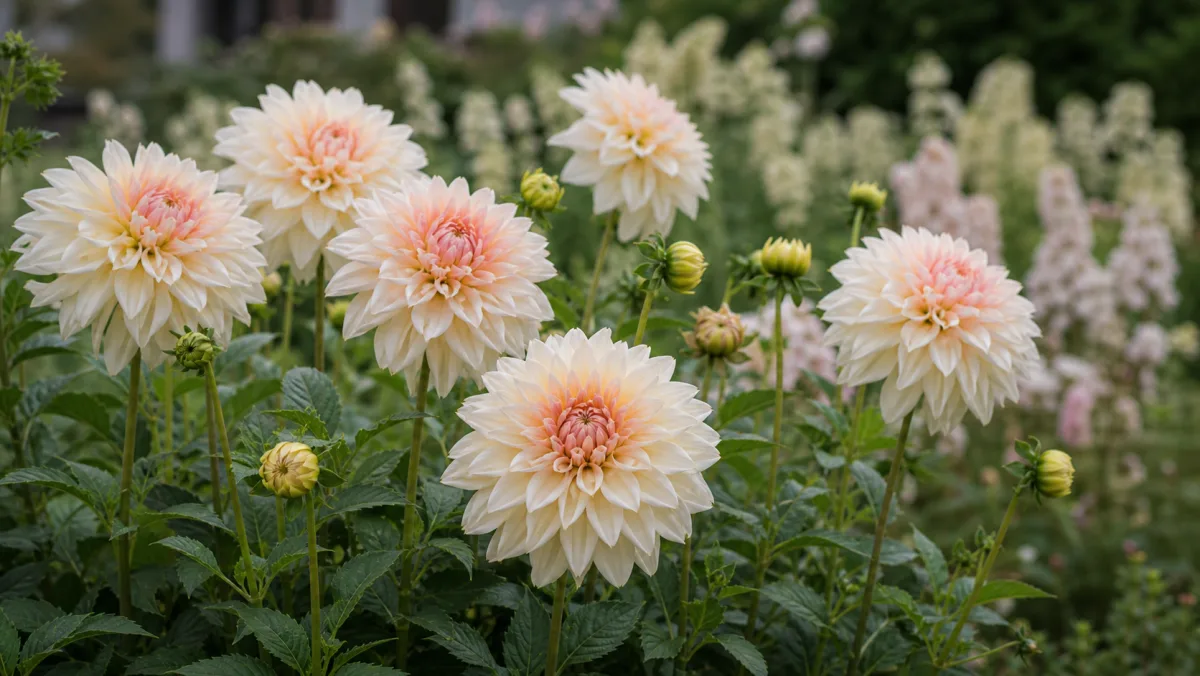
Dahlia ‘Diana’s Memory’ is recorded at about 70 cm high, with double flowers to 10 cm—smaller in scale than many tall cutting dahlias. The flowers are creamy white, flushed pink and yellow towards the base, not peach or an unspecified pastel blend. That combination suits a reachable border position where the colour can be seen close up, but the recorded height is guidance rather than a fixed finish. Soil, light, pinching and weather decide how the clump occupies its space.
Let the recorded scale set the viewing distance for 'Diana's Memory'
A flower around 10 cm wide reads differently from an exhibition-scale bloom. ‘Diana’s Memory’ rewards a position close enough to see the pink flush and yellow base, rather than a distant slot where pale flowers merge into sky or paving glare. The front or middle of a border can work if taller neighbours will not lean over it later in the season.
About 70 cm is a useful spacing clue, not a measuring contract. Check the eventual width offered by the seller, leave air around the crown and keep a hand-width route for deadheading. Crowding the plant to display it near a path can hide the very flowers the placement was meant to show.
A low open support ring is often less conspicuous than a tall stake. Install it early if the site is windy or if neighbouring foliage may push the stems sideways; otherwise observe the young clump before adding ties it does not need.
- View the flower from near enough to see its pale colour transitions.
- Keep the crown clear of leaning neighbours.
- Match support to exposure and stem behaviour, not to habit alone.
A season built around access rather than maximum height
- Before growth accelerates: choose sun and free drainage, set a discreet ring if exposure warrants it, and secure the cultivar label beside the root position.
- As the clump fills out: water deeply in dry periods, inspect stems inside the support and remove competition that blocks light or hand access.
- During flowering: cut firm, fully open blooms or deadhead to a leaf junction; reassess pale flowers against their neighbours before moving any plant.
- At seasonal dieback: keep the named label attached and protect the tuber from freezing and prolonged winter wet according to local conditions.
Keep the colour description precise
The recorded colour is creamy white with a pink flush and yellow towards the flower base. That wording matters because broad terms such as blush, peach or antique can make several unrelated pale dahlias sound interchangeable. The flower may look warmer or cooler as it ages and under different light, but the recorded description remains the better identity check.
Give pale flowers a backdrop with some tonal contrast. Deep green leaves, a dark fence or repeated mid-tone foliage makes the 10 cm flower easier to read; a mass of equally pale neighbours can erase its outline. This is a composition decision, not a claim that one companion improves plant health.
If a new plant opens with a wholly different form or colour, photograph the flower and the label together before contacting the supplier. Do not rename a plant from a single weather-damaged bloom.
Questions about ‘Diana’s Memory’
What does Dahlia ‘Diana’s Memory’ look like?
The double flowers reach about 10 cm and are creamy white with a pink flush and yellow towards the base. Avoid substituting peach or stronger colours that are not in the recorded description.
How tall is it?
Use about 70 cm as a spacing guide. Local light, feeding, weather and pinching can change the finished plant, so do not treat the figure as a guaranteed line.
Is it suitable for the front of a border?
Its recorded scale can work near a border edge if the position is sunny, drained and reachable. Leave enough room to deadhead without leaning across lower neighbours.
Should I lift the tuber?
Lift and store it frost-free where cold, wet winter soil puts the tuber at risk. In milder free-draining ground, some gardeners leave dahlias in place under protection, but survival is not assured.
Protect the root zone while keeping stems reachable
Plant into fertile soil that drains after rain. During a dry spell, water the root area thoroughly and allow the surface to begin drying before the next check; repeated light sprinkling can wet leaves without reaching the deeper roots. Keep mulch away from direct contact with the stems.
For cutting, wait until the flower is fully open and firm. Use clean tools and cut back to a junction that preserves useful branching. A short plant does not automatically yield short stems: the available cutting length depends on where the flower stalk joins the framework.
In a pot, root volume and stability become the limiting factors. Choose a broad container with open drainage and enough weight to remain upright, then check moisture more often than in a border without leaving the pot standing in water.
Carry the name through winter
Dahlias are tender. In climates or sites where frost and winter saturation threaten the tuber, lift after seasonal dieback and allow excess soil to dry before storage. Keep the crown intact, remove clearly damaged tissue with clean tools and do not combine unlabelled tubers in one tray.
A cool, dark, frost-free place should prevent both freezing and premature growth. Inspect the stored tuber occasionally for spreading rot or severe desiccation. Storage material should buffer moisture without sealing a wet tuber into an airtight box.
Attach ‘Diana’s Memory’ to the container or bundle. Its value next season lies in returning the known 70 cm-scale, creamy-white and pink-flushed cultivar, not merely in producing another unidentified dahlia.