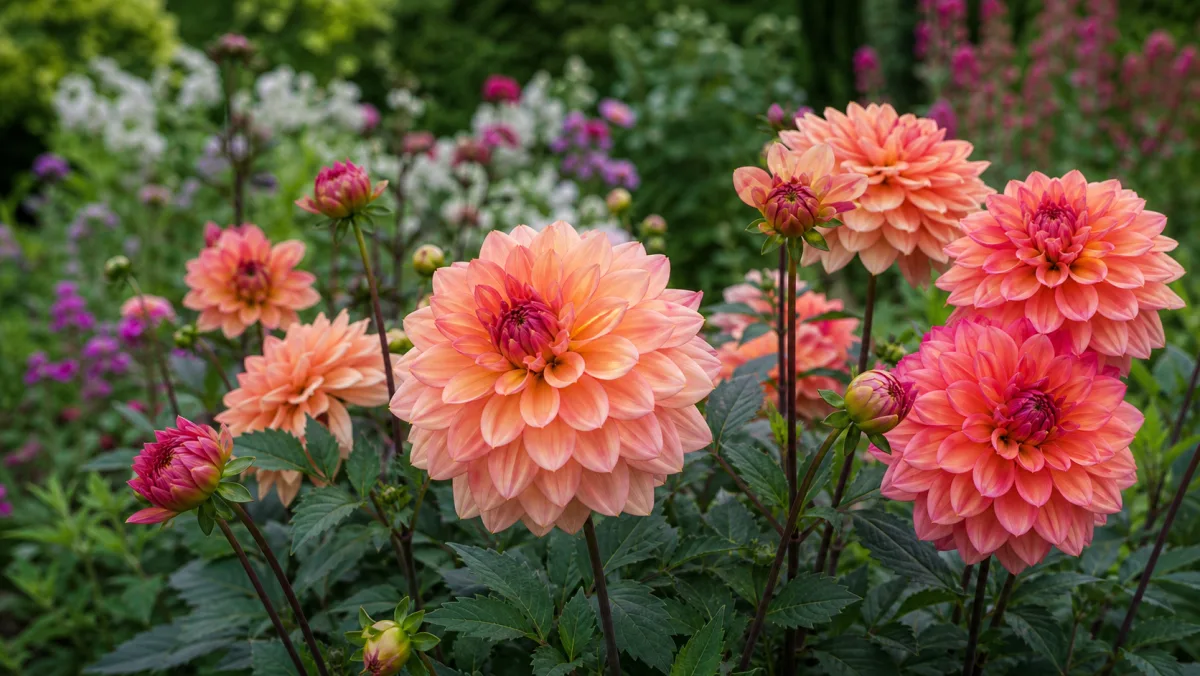
Dahlia 'American Dawn' brings apricot, coral, raspberry and warm orange tones to stems around 90-110 cm high. Give it a sunny drained bed, stake before the stems fill out, keep a clear cutting path and reserve cool frost-free storage for the labelled tuber after autumn lifting.
Warm colour on stems that need working room
'American Dawn' combines apricot, coral, raspberry and warm orange tones on a plant expected to reach roughly 90-110 cm. That height makes it a middle- or back-border dahlia rather than a low edging plant, and it needs a route for tying stems and cutting flowers without leaning across neighbouring plants.
Treat the cultivar as a stored tuber crop as well as a summer flower. The bed must warm before planting, support should be ready before stems become brittle, and frost-free storage space must exist before autumn lifting becomes urgent.
Flowering may run from midsummer into autumn where conditions allow, but local frost and the condition of the plant set the end point. Regular cutting or deadheading keeps inspection close enough to notice loose ties, dry soil or damaged stems.
- dahlia tuber.
- apricot, coral, raspberry and warm orange tones.
- 90-110 cm.
Give 'American Dawn' a sunny bed and an accessible stake
Choose a sunny, drained position where a 90-110 cm plant will not block a path. Place the stake before or at planting and keep the base reachable for slow watering, label checks and later lifting.
Look beyond summer colour to the autumn route: tubers need to be dug without damaging nearby perennials, dried, labelled and held cool and frost-free. If that sequence is impractical, grow fewer plants or use a position with easier access.
- a sunny, drained position with room for 90-110 cm growth
- a stake that can be installed before the stems branch around it
- an open side for watering, tying and cutting warm-toned flowers
- cool frost-free storage that keeps the lifted tuber labelled
Start the tuber without rushing cold soil
If an earlier start is wanted, wake the tuber under cover in a container that can be moved without breaking new shoots. Move it outside only after local frost risk has passed and the planting soil is workable and warming.
Set a stake at planting so the 90-110 cm stems can be tied while still flexible. Water the root zone deeply after planting, then let soil condition—not a repeating date—decide the next watering.
A season built around tying, cutting and lifting
- Early spring: inspect the labelled tuber and start it under cover only if you can provide light and frost protection.
- After frost risk: plant into a sunny, drained bed and install the stake before shoots spread.
- Midsummer to autumn: tie new growth, cut or deadhead regularly and keep the access side of the plant open.
- After frost ends the display: lift, dry and label the tuber before moving it into cool frost-free storage.
Keep 90-110 cm stems upright and within reach
Check the tie after wind and as each new tier of growth passes the stake. Water at soil level when the root zone needs it, keeping the foliage and the path open enough to cut warm-toned flowers without snapping side stems.
A sudden loss of vigour calls for a root-zone and stem check: look for saturated soil, drought, loosened support or damaged growth before changing the feeding routine. Remove spent flowers so inspections happen frequently through the main display.
Problems to catch before the stems become heavy
'American Dawn' is most vulnerable when support and access are postponed until its warm-toned flower stems are already carrying weight.
- placing a 90-110 cm plant where the stake or cutting side cannot be reached
- starting too early without enough light or reliable frost protection
- watering by calendar while the bed is still wet after rain
- lifting several cultivars together without labels for winter storage
Use the warm palette as a middle-border bridge
Use 'American Dawn' where apricot, coral and raspberry tones can connect hotter oranges with softer pink planting. Its 90-110 cm height suits the middle or rear of a border that still has a clear cutting side.
Choose shorter neighbours at the access edge and avoid vigorous plants that hide the stake. If another dahlia shares the bed, give each tuber a permanent label before foliage closes the gap.
Questions about Dahlia 'American Dawn'
How tall does 'American Dawn' grow, and will it need support?
Plan for roughly 90-110 cm and install a stake at planting. Tie stems while they are flexible, especially where wind or repeated cutting can pull the plant away from its support.
When can the tuber be planted outside?
Wait until local frost risk has passed and the soil is workable and warming. An indoor start can bring earlier growth, but the new shoots still need light and protection until outdoor conditions are safe.
How do I keep the warm-toned flowers accessible for cutting?
Leave one side of the plant free of tall neighbours, tie growth close to the stake and cut or deadhead before spent blooms disappear inside the canopy. That route also makes moisture and stem damage easier to inspect.
What should happen to the tuber at the end of the season?
After frost ends the display, lift the tuber without mixing it with nearby cultivars, allow it to dry and keep it labelled in cool frost-free storage. Check the stored tuber periodically rather than forgetting it until spring.