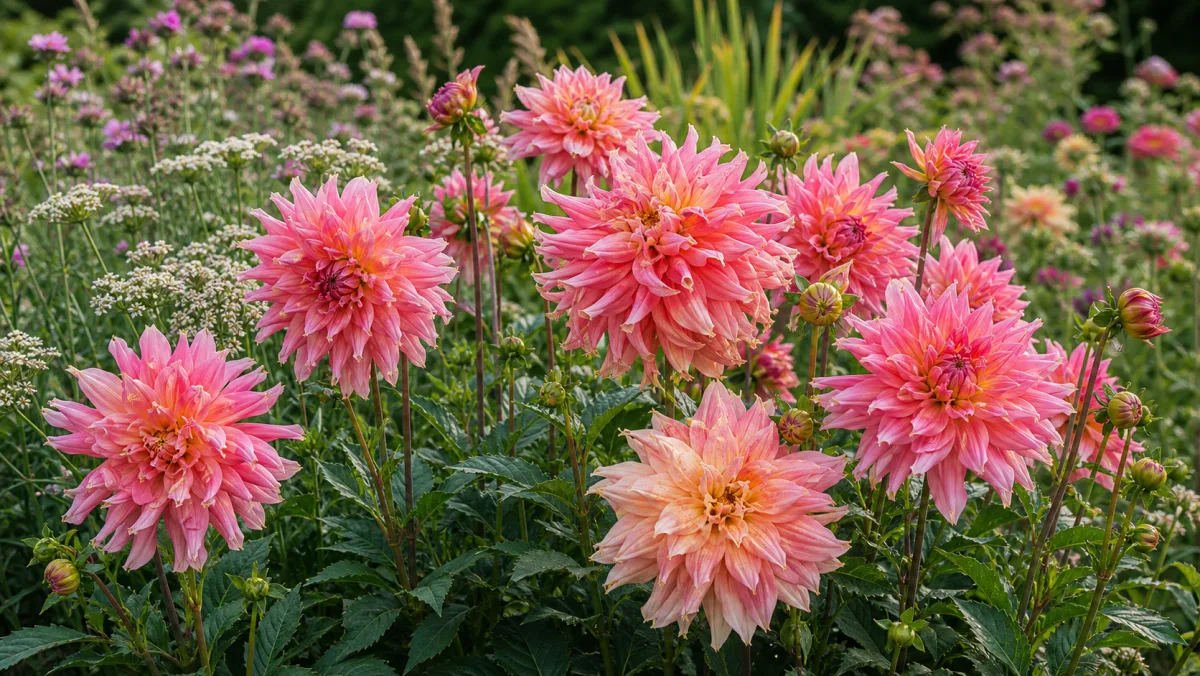
'Penhill Watermelon' produces broad informal flowers that blend pink, peach and apricot on stems planned at roughly 110–140 cm. A sheltered position and upper ties matter because wet flowerheads pull outward; leave a path-facing side for cutting and storm checks.
Read the pink, peach and apricot informal flower
Treat Dahlia 'Penhill Watermelon' as a site decision, not just a plant profile. dahlia tuber, watermelon pink, peach and apricot and 110-140 cm set the practical limits for the bed, pot, support or harvest route.
The pink, peach and apricot petals form a large informal bloom with a soft, open outline. Place it where side light can show those colour transitions and where a path gives access to the upper ties after rain.
Keep July to frost in view as a limit. If the site cannot deliver Watermelon pink, peach and apricot without crowding or weak stems, move Dahlia 'Penhill Watermelon' before buying companions or adding equipment.
- dahlia tuber.
- watermelon pink, peach and apricot.
- 110-140 cm.
Choose shelter for broad heads on 110–140 cm stems
Start with the place. Dahlia 'Penhill Watermelon', match tuber, support and winter storage with the bed edge, pot, path, wind exposure and water access before work starts.
Then compare the season with the work you can repeat. For Dahlia 'Penhill Watermelon', concentrate on the constraint created by Watermelon pink, peach and apricot and record one adjustment after the season instead of applying a generic dahlia checklist.
- buying Dahlia 'Penhill Watermelon' without space to display Watermelon pink, peach and apricot, accessible support and a labelled frost-free storage place
- following a printed date despite cold soil, saturated ground or wind that threatens Watermelon pink, peach and apricot on stems of 110-140 Cm
- placing Dahlia 'Penhill Watermelon' where Watermelon pink, peach and apricot cannot be reached for tying, cutting or autumn lifting
- ending the season without recording how Watermelon pink, peach and apricot performed or keeping the cultivar label with the tuber
Anchor 'Penhill Watermelon' before summer rain arrives
Before planting Dahlia 'Penhill Watermelon', prepare drainage, a stake, a working path and a label that will remain with Watermelon pink, peach and apricot through lifting and storage. Make corrections while the shoots are short; once Watermelon pink, peach and apricot is carried on growth of 110-140 Cm, moving ties or reaching the crown becomes riskier.
Use the calendar only as a guide. In a temperate garden, cold nights, heavy rain, heat and drying wind can move the right moment Dahlia 'Penhill Watermelon' by several weeks.
A support-first calendar for watermelon-toned blooms
- Tuber, support and winter storage.
- Dahlia tuber.
- Watermelon pink, peach and apricot.
- 110-140 Cm.
Check upper ties after rain and cutting
The care routine Dahlia 'Penhill Watermelon' should be simple enough to repeat: check moisture or surface, check airflow or access, then check the next seasonal task.
If Dahlia 'Penhill Watermelon' struggles, first inspect drainage, shoot damage and support around its pink, peach and apricot blooms; extra water or feed cannot correct a badly chosen site. Because the large informal heads can hold rain and pull outward, check the upper ties and shelter after a storm before diagnosing the plant as weak or increasing fertiliser.
What makes the large pastel heads lean or bruise
The main avoidable errors are losing the cultivar label, adding support after stems lean and hiding Watermelon pink, peach and apricot behind inaccessible neighbours.
- buying Dahlia 'Penhill Watermelon' without space to display Watermelon pink, peach and apricot, accessible support and a labelled frost-free storage place
- following a printed date despite cold soil, saturated ground or wind that threatens Watermelon pink, peach and apricot on stems of 110-140 Cm
- placing Dahlia 'Penhill Watermelon' where Watermelon pink, peach and apricot cannot be reached for tying, cutting or autumn lifting
- ending the season without recording how Watermelon pink, peach and apricot performed or keeping the cultivar label with the tuber
Use lower neighbours without blocking the working side
Choose lower or narrower neighbours that keep Watermelon pink, peach and apricot visible and leave a clear route to support, cut and lift Dahlia 'Penhill Watermelon'.
Use neighbouring plants as shelter only if they remain below the informal watermelon-toned flowerheads. The useful follow-up guides are those that help brace tall stems before rain, maintain a cutting path and lift the bulky crown without damaging nearby perennials.
FAQ about Dahlia 'Penhill Watermelon'
How should the watermelon-toned heads be displayed?
Use side light and lower companions to show the pink, peach and apricot transitions. Keep one path-facing side open because the broad informal heads need tie checks and cutting after rain.
What conditions justify planting 'Penhill Watermelon' outdoors?
Wait for the end of damaging frost and warm, freely drained soil. Its stake belongs in the ground before planting so the future 110–140 cm framework is secure without disturbing roots.
Why do the upper stems lean after rain?
Large loose flowerheads hold water and pull outward. Inspect upper ties and shelter, remove damaged blooms and rebalance the framework before assuming the tuber needs more feed.
What practical reading helps this Penhill cultivar?
Use guidance on bracing tall, flower-heavy dahlias and on cutting long stems from an accessible side. Storage advice matters when the bulky crown is lifted near established perennials.