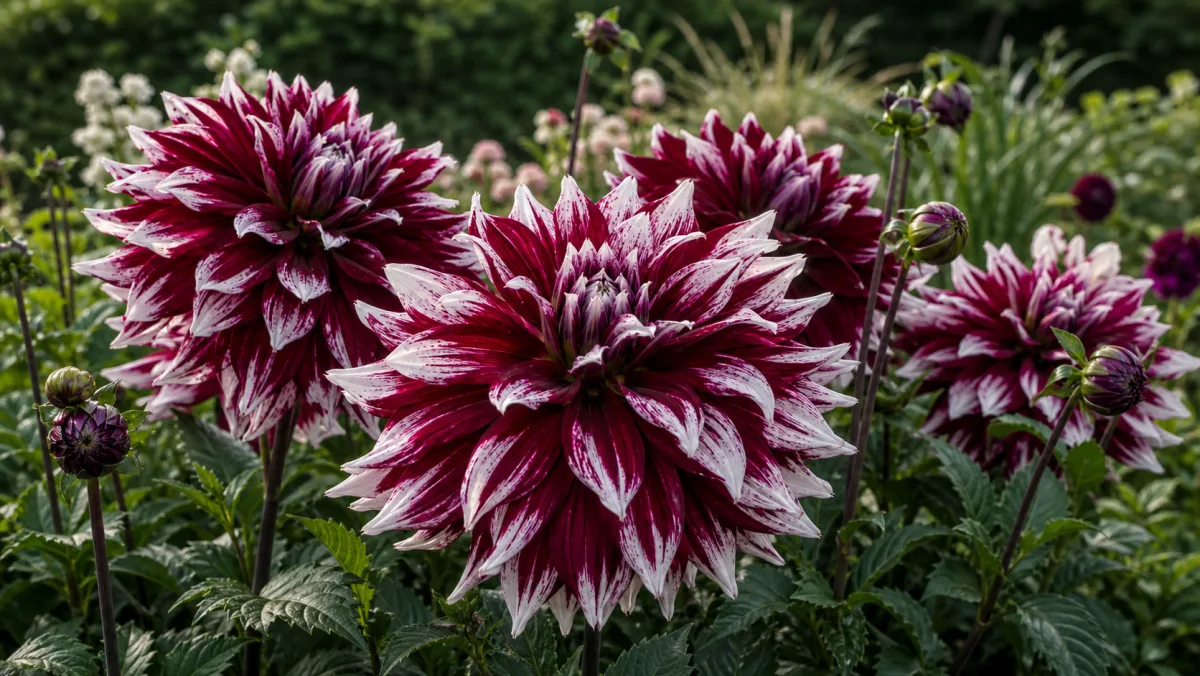
The defining feature of Dahlia ‘Tartan’ is a large, ruffled, fully double decorative flower: dark burgundy red with white at the tips and edges. Treat 0.5–1 m as a source-profile range rather than a promise; flower load and exposure should decide the support. A double head holds rain and catches wind, so this cultivar belongs in a sheltered, sunny position where a strong framework can be installed before the stems disappear into the border.
Dahlia 'Tartan': judge the site by the flower load after rain
‘Tartan’ forms an upright, bushy clump, yet its large double flowers create leverage at the top of each stem. A position that seems calm at ground level may be turbulent above a fence or at the end of a wall. Watch the intended spot during rough weather before committing the tuber.
Full sun, fertile soil and reliable drainage support flowering, while shelter reduces the repeated bending that loosens ties. Avoid a low hollow that remains wet after storms. If the only sunny place is exposed, use a fixed grid or several stout canes rather than one central stake that leaves outer stems unsupported.
Set the support when shoots are still easy to separate. A loose outer ring lets stems move slightly without sawing against twine, and a second level can be added as flower stalks lengthen.
- Check wind at flower-head height, not only at soil level.
- Use several support points for a branching clump.
- Keep one side open for deadheading and disease checks.
Decorative is a flower class, not an endorsement
‘Tartan’ is an accepted cultivar name in the decorative group. In dahlia classification, decorative flowers are fully double, show no disc and have broad ray florets. These terms describe identity; they do not promise performance, perfect symmetry or an award.
Its recorded colour is dark burgundy red with white tips and edges. Light, temperature and the age of a bloom change how colour appears to the eye and camera, so match a purchased plant to its label and overall flower pattern rather than expecting a catalogue image to reproduce exactly.
Use the high contrast deliberately. Against a plain green hedge or restrained foliage the flowers remain legible; among many other patterned blooms the white edging can disappear into visual noise.
Water the root zone without keeping the crown sodden
Dahlias grow quickly once warm conditions arrive. In dry weather, soak the soil around the root zone rather than sprinkling the leaves and flower heads. A surface mulch can slow evaporation, but leave a small gap around the stems and check that water still drains through the bed.
Container-grown ‘Tartan’ needs enough soil volume to resist both drying and toppling. Choose a heavy, broad-based pot with an unobstructed drainage hole, then anchor the support independently of a shallow layer of compost. A narrow lightweight pot is a poor counterweight for several wet double flowers.
Remove faded flowers back to a leaf joint. Deadheading keeps the clump navigable and directs growth away from seed production, but it cannot compensate for shade, a cramped root run or persistently waterlogged soil.
Four checks from planting to storage
- Before planting: choose a sunny, sheltered position and put the main support into place without risking damage to an established crown.
- As stems branch: spread ties across the framework, water deeply during dry spells and inspect the undersides of leaves rather than waiting for visible collapse.
- As large flowers open: cut or deadhead back to a junction, and add support before forecast wind or prolonged rain loads the heads.
- When the season closes: retain the label, remove frost-damaged top growth and lift for cool frost-free storage wherever local winter conditions threaten the tuber.
Questions about Dahlia ‘Tartan’
What distinguishes Dahlia ‘Tartan’?
It has large, ruffled, fully double decorative flowers in dark burgundy red with white tips and edges. ‘Decorative’ describes flower form; it is not a quality award.
How tall does ‘Tartan’ grow?
Treat 0.5–1 m as a source-profile range and confirm the plant label. Climate, soil and care can change the finished height.
Does it need staking?
Plan to support it. The upright stems carry large double heads, and rain or wind can multiply the load long before the plant reaches its maximum height.
Can the tuber stay outdoors in winter?
Only where winter conditions and drainage make that risk acceptable. In freezing, exposed or wet conditions, lift the labelled tuber and store it cool, dry and frost-free.
Decide from flower load, access and labelled storage
Choose 'Tartan' for its burgundy-and-white decorative flowers only where a firm support can be installed before the large double heads open.
Leave one side reachable for ties, cutting and autumn lifting, and keep the cultivar label with the crown when it moves into frost-free storage.