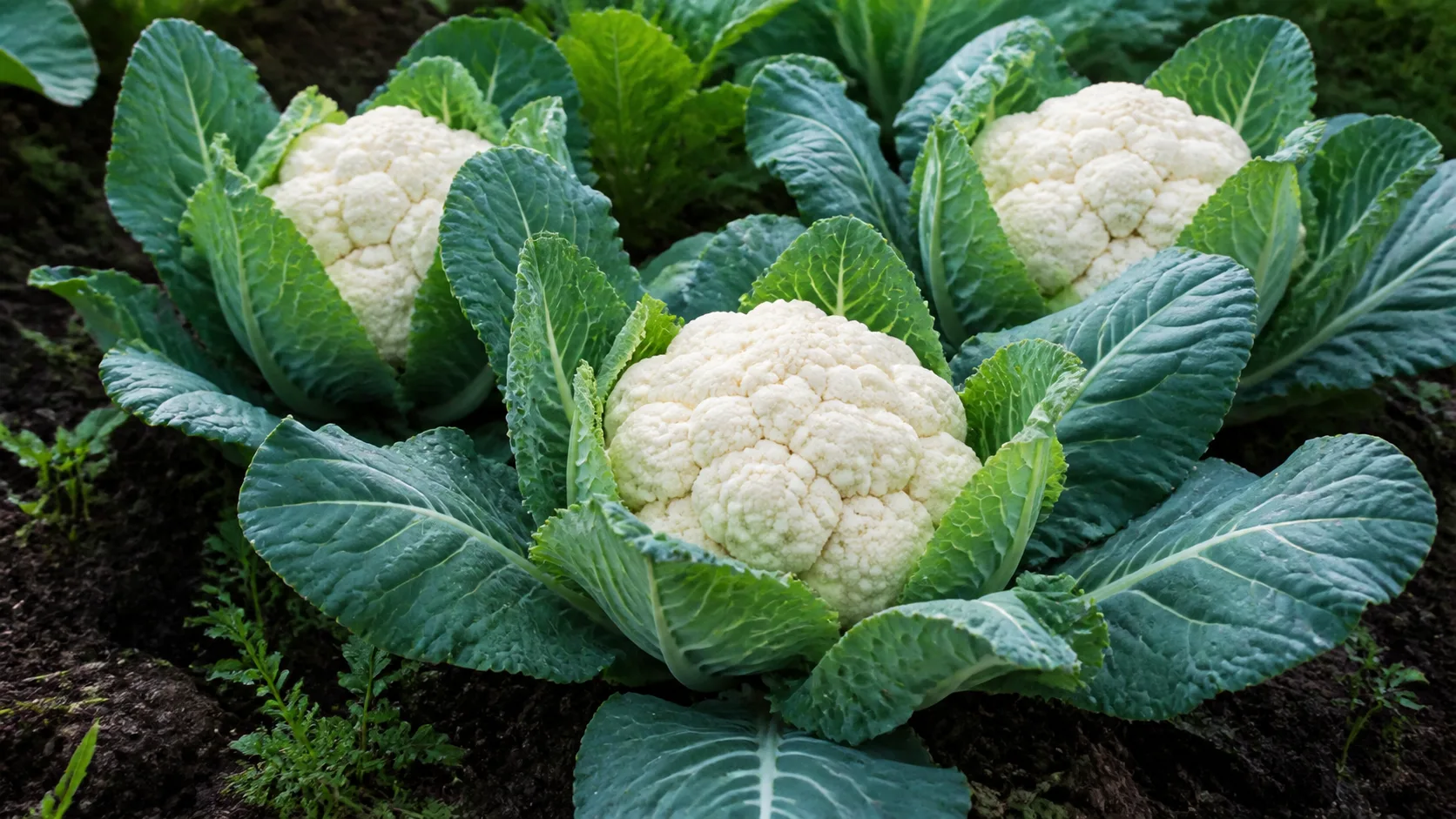
Cauliflower forms its curd only after weeks of steady leaf growth, so the useful plan starts with a cool growing window, fertile drained soil and uninterrupted moisture. Raise sturdy modules, protect young brassicas before cabbage root fly reaches them, and inspect the centre regularly: a firm compact head is ready to cut, while a stalled plant rarely recovers through extra feeding alone.
Why cauliflower needs an even growing rhythm
Cauliflower is a cool-season brassica grown for the dense immature flower head at the centre of a broad rosette. Its 40-70 cm spread makes spacing consequential: crowded plants are difficult to inspect and cover, while an exposed dry edge can interrupt the even growth needed before curd formation.
Choose a bed that can hold moisture without remaining waterlogged and that can be covered securely against cabbage root fly. The crop also needs regular access for watering and for checking the central leaves, because pest damage or a loose curd is easier to act on early.
Harvest is decided by the head rather than a universal month. Cut while the curd is firm and compact; if the surface begins to loosen, waiting for a larger head sacrifices texture rather than adding useful yield.
- brassica crop.
- white heads, blue-green leaves and healthy soil.
- 40-70 cm.
Choose a sunny, fertile bed you can protect
A practical cauliflower bed has room for the mature leaf rosette, a nearby water source and edges where insect mesh or fleece can be sealed. Check that the cover will not press against the growing centre and that rain can drain rather than pond around the stem.
Match the sowing batch to a reliably cool part of the local season. If heat or drought usually arrives before plants can make a strong leaf frame, a later or earlier batch is more sensible than forcing the crop through stress.
- choosing Cauliflower before fleece, moisture and curds have been checked on the actual site
- following a fixed date when soil, wind, rain, heat or frost says wait, with the watering detail checked against Cauliflower.
- placing cauliflower where the insect cover cannot be sealed or the central curd cannot be inspected
- forgetting to note what should change before the same choice is repeated next season, with the seasonal step narrowed to Cauliflower.
Raise sturdy modules before planting out
Prepare the bed and its pest cover before transplanting cauliflower modules. Once the outer leaves overlap, sealing mesh edges and correcting uneven irrigation becomes slower and risks disturbing the shallow active roots.
Use the calendar only to identify a likely cool-season window. Transplant when modules are sturdy, the bed is workable and protective mesh can be fitted immediately; postpone if saturated soil would smear around the roots.
From indoor sowing to firm white curds
- Fleece, moisture and curds.
- Brassica crop.
- White heads, blue-green leaves and healthy soil.
- 40-70 Cm.
Keep roots moist and protection intact
During each watering round, inspect the central leaves, the stem at soil level and the edges of the protective mesh. Those three checks reveal stalled curd growth, early pest damage and gaps where adult cabbage root flies could enter.
A plant that wilts in wet soil needs a root and drainage check, not another watering. If leaves remain small, examine root-fly damage and earlier interruptions before feeding; when only the curd is loose, heat or delayed harvest may be the more useful explanation.
Setbacks that prevent compact heads
Compare fleece, moisture and curds with the actual site, then note the change before the next season.
- choosing Cauliflower before fleece, moisture and curds have been checked on the actual site
- following a fixed date when soil, wind, rain, heat or frost says wait, with the watering detail checked against Cauliflower.
- placing cauliflower where the insect cover cannot be sealed or the central curd cannot be inspected
- forgetting to note what should change before the same choice is repeated next season, with the seasonal step narrowed to Cauliflower.
Use pest guides to diagnose root and leaf damage
Keep other brassicas far enough away that each cauliflower rosette can be inspected and its cover remains taut. Avoid following another demanding brassica in depleted soil unless fertility and crop-rotation risks have been addressed.
Compare the cabbage-root-fly and vegetable-watering guides when planning the bed; those decisions affect cauliflower more directly than decorative companion-plant lists.
Cauliflower questions
What conditions help cauliflower form a compact head?
Cauliflower needs fertile, well-drained soil, even moisture and a steady transition from module to bed. Keep protection secure against likely brassica pests, then harvest while the white head is still firm and compact.
When should young cauliflower plants go into the bed?
Plant out sturdy modules once the bed is prepared and local conditions allow them to establish without an abrupt cold, dry or waterlogged spell. Water the root ball in and protect it immediately rather than leaving tender plants exposed while the rest of the row is finished.
Why can cauliflower stall before a head forms?
Check for interrupted growth rather than adding feed automatically. Dry root zones, saturated soil, cabbage-root-fly damage, torn protection and plants held too long in small modules can all prevent the even growth that cauliflower needs.
How can the cabbage-root-fly guide help this crop?
Use the cabbage-root-fly guide to identify risk, fit insect mesh before adults reach the crop and distinguish pest damage from ordinary drought stress.