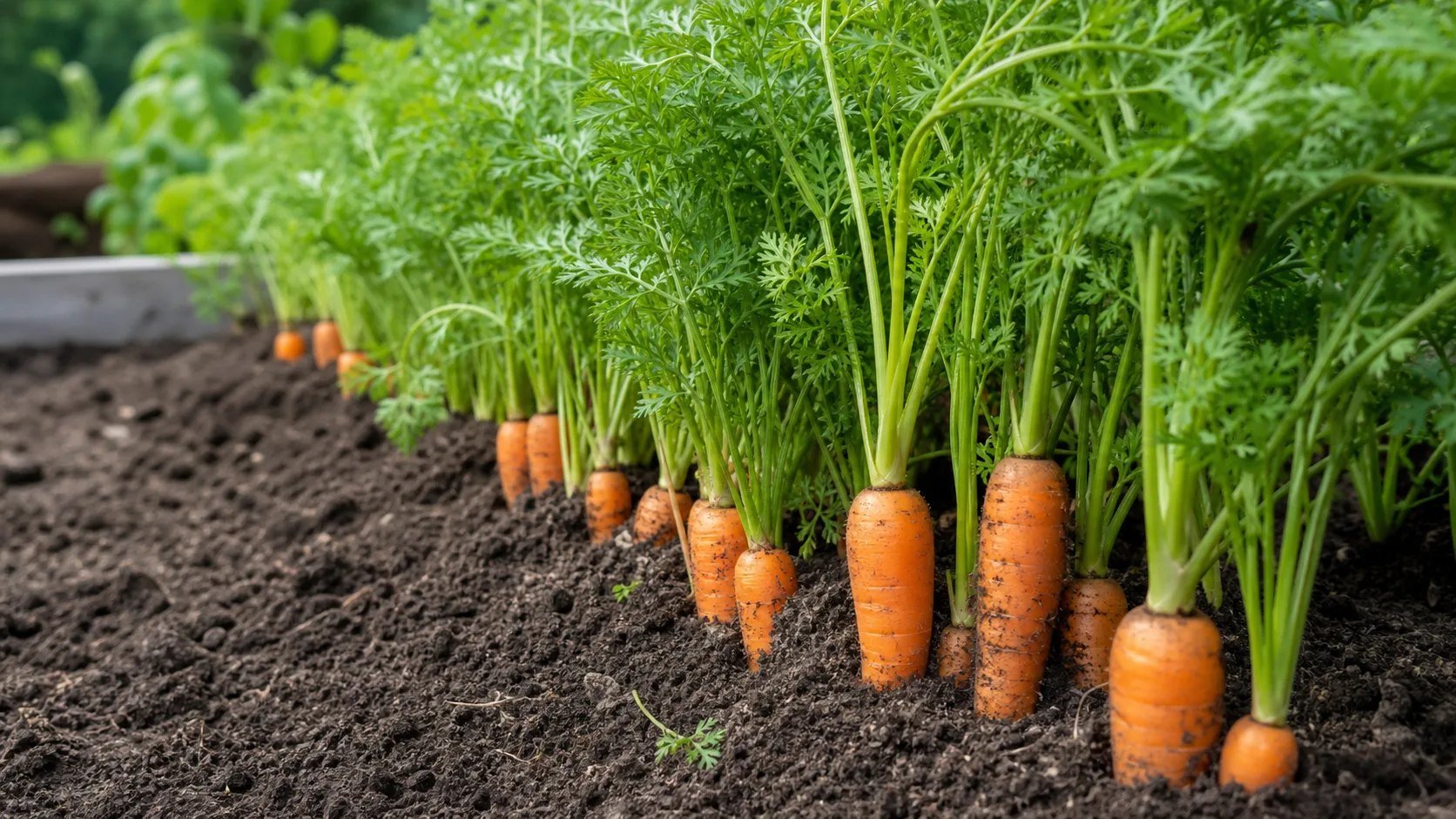
A straight carrot starts with the seedbed: deep, loose soil without stones or fresh lumps of manure, a shallow 1 cm drill and steady moisture while slow-germinating seed wakes. Direct sowing avoids disturbed roots, while succession sowing turns one crowded harvest into a useful run from summer into autumn.
Root shape is decided below the surface
Carrots need depth as well as a crumbly surface. Stones, compacted layers and undecomposed organic matter can deflect or fork the developing taproot, so prepare the bed before opening the seed packet. A raised bed or deep container is useful where native soil is shallow or stony.
Choose a variety suited to the available depth and intended harvest. Short-rooted carrots make better use of containers, while long maincrop types need a deeper run. The foliage may reach 20-40 cm, but the important competition occurs underground.
- Break clods and remove stones from the rooting depth.
- Avoid adding fresh manure immediately before sowing.
- Mark rows clearly because seedlings emerge slowly.
Use a clean seedbed and sow directly
Direct-sow carrots into fine, stone-free soil and seal insect-proof mesh over the crop before carrot fly can reach it. Draw a drill about 1 cm deep, sow thinly and space rows roughly 15-30 cm apart. Cover lightly, label the row and water with a fine rose so seed is not washed into clusters.
A stale seedbed suppresses early weeds before slow-germinating carrots emerge, provided the surface is cleared with minimal further soil disturbance. Encourage weed seeds near the surface to germinate, remove those seedlings without deeply disturbing the soil, then sow the carrots.
- Sow into moist soil and keep the top layer from crusting.
- Make short succession sowings rather than one oversized row.
- Use fresh seed and do not assume a bare row has failed too early.
- Pull weeds while small, with minimal disturbance around seedlings.
Thin once, then keep moisture even
Thin crowded seedlings so the remaining roots have room to swell; about 7-8 cm is a useful final spacing for many garden carrots. Work when the soil is moist, remove thinnings from the bed and firm the disturbed surface around the survivors.
Water deeply enough to reach the roots, then allow the surface to settle rather than giving frequent token splashes. Keep irrigation uniform, then use cool humid storage for sound roots and keep stored carrots away from apples. A prolonged dry spell followed by abundant water can make mature roots split.
From a stale seedbed to the final lifted roots
- Before sowing: prepare fine, deep soil and remove the first flush of weeds.
- At emergence: distinguish feathery carrot seedlings from weeds and keep the row moist.
- After establishment: thin to useful spacing and maintain the insect barrier.
- July to October: lift roots according to sowing date, variety and the size you prefer.
Exclude carrot fly before damage begins
Carrot-fly larvae tunnel through roots and can make a crop unusable. Fine insect mesh or horticultural fleece is most reliable when it covers the crop from sowing and has no gaps at the edges. Fit the barrier before thinning scents advertise the row.
Avoid crushing foliage while weeding, and take thinnings away promptly. A low solid barrier can reduce access because the adult fly stays close to the ground, but a complete insect-proof cover offers clearer protection.
- Seal mesh edges with soil, boards or secure pegs.
- Allow slack so foliage can grow without lifting the cover.
- Inspect after wind and after every harvest opening.
Diagnose misshapen, split or weak roots
Forked roots usually point back to stones, compaction, fresh organic matter or early root disturbance. Hairy roots can accompany unsuitable soil conditions, while green shoulders occur when the top of the root is exposed to light; draw a little soil over exposed crowns.
Small roots may reflect crowding, shade, drought or simply an early harvest. Split roots are often associated with uneven moisture. Read the root and the bed history together before changing fertiliser.
- Sowing into coarse soil and expecting straight roots.
- Leaving seedlings crowded because thinning feels wasteful.
- Opening insect mesh and failing to reseal every edge.
- Flooding a dry bed just as mature roots approach harvest.
Harvest for size, flavour and storage
Pull a test carrot when the shoulders reach a useful diameter rather than waiting for every root to become identical. Water dry ground beforehand and loosen alongside long roots with a fork to reduce breakage. Successive sowings can provide harvests from July into October, depending on variety and weather.
Remove foliage before storage so it does not draw moisture from the root. Before eating raw carrots, wash them under running water and do not use soap or detergent on the produce. Keep only sound roots and cut away damaged or rotten areas.
- Lift one root to judge size before clearing a row.
- Separate damaged carrots for immediate use.
- Record which sowing date and spacing produced the most useful roots.
FAQ about Carrots
Why should carrots be sown directly?
The edible taproot is easily disturbed by transplanting. Direct sowing into fine, deep soil gives it the clearest route to grow straight.
How deeply should I sow carrot seed?
Use a shallow drill about 1 cm deep, cover lightly and keep the surface moist while the slow-germinating seed emerges.
What causes forked or split carrots?
Stones, compaction, fresh manure or root disturbance can cause forks. Splitting is often linked to a dry spell followed by abundant water.
How can I prevent carrot fly damage?
Cover the crop with fine insect mesh from sowing, seal every edge and remove thinnings promptly so the row is not left exposed.