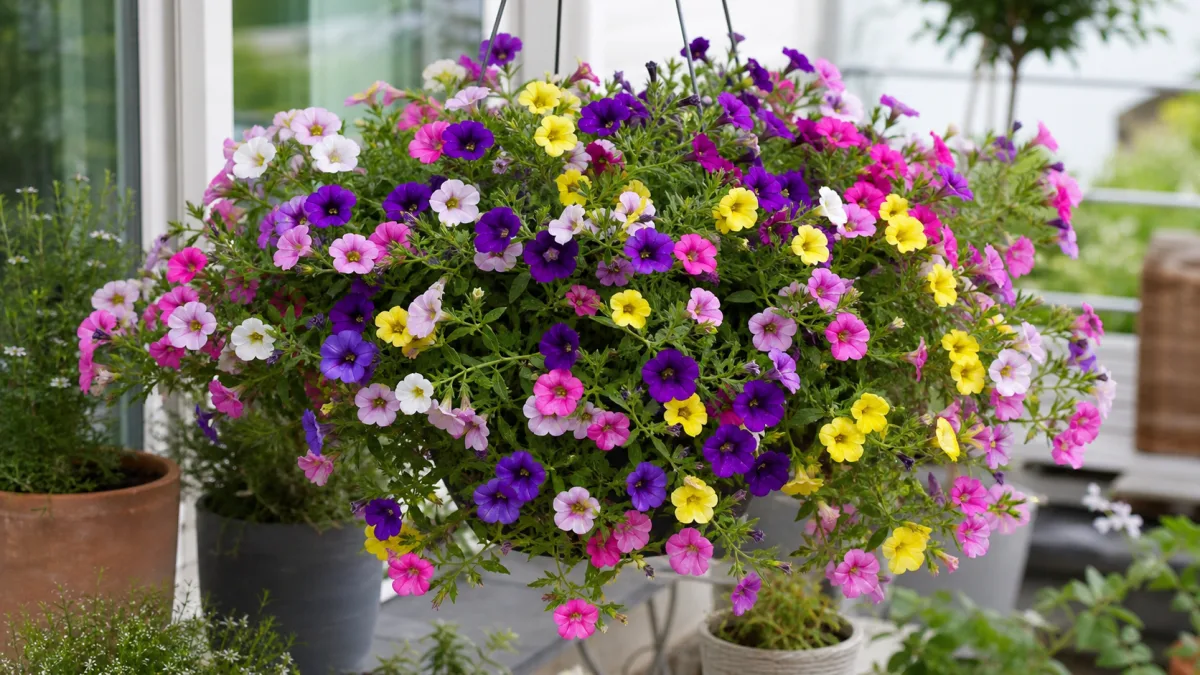
Calibrachoa grows about 15-30 cm high before its stems trail roughly 30-60 cm over a basket, window box or container edge. That shape puts a large flowering canopy above a small root volume, so choose a sunny, sheltered position where drainage holes stay open and the pot can be watered without lifting brittle stems.
A long flowering curtain above a small root zone
Calibrachoa forms a low crown around 15-30 cm high, then trails roughly 30-60 cm from baskets, window boxes and containers. Purple, pink, yellow, white, red, orange and bicoloured selections all put the same pressure on a relatively small root zone.
Choose the pot for water capacity and drainage before choosing the colour mix. Open holes and a free-draining compost allow a thorough watering to reach the roots without leaving the crown sitting in saturated material.
With steady water and feed, flowering can continue from early summer until frost. A neglected basket can dry rapidly, while a waterlogged one loses healthy roots; the useful routine sits between those two failures.
- Type: trailing summer flower for baskets, containers and window boxes (Calibrachoa).
- Colours: purple, pink, yellow, white, red, orange and bicoloured varieties.
- Height: about 15-30 cm high, often trailing 30-60 cm.
Choose a basket you can water safely
Stand at the intended hanging point before buying. You should be able to feel the compost, water the full root ball and inspect the hook or bracket without balancing over trailing stems.
Sun to light partial shade can work, but reflected heat and drying wind shorten the watering interval. Shelter from hard rain also helps the small flowers and long stems remain presentable.
- Use a container with unobstructed drainage holes and enough compost volume for the mature plant.
- Count the wet weight of pot, compost, plant and water when checking a hanging support.
- Keep a safe watering route throughout the season, not only while the stems are short.
- Choose companions that tolerate the same light, moisture and feeding routine.
Plant after frost into free-draining potting mix
Plant after local frost risk has passed. Set the root ball into fertile, free-draining potting mix at its existing depth, leave a watering rim and soak the container until excess water leaves through the base.
Do not crowd the crown with decorative mulch or neighbouring root balls. Early space and airflow make it easier to see whether new growth is branching evenly and whether the compost is accepting water across the whole pot.
From spring planting to the first frost
- Before planting: clear the drainage holes, test the hanging support at wet weight and prepare a safe watering route.
- After frost risk: plant at the existing depth, water the full root ball and protect new growth from cold nights and severe wind.
- Main flowering season: check moisture frequently, feed according to the product label and trim isolated tired stems back to leafy growth when needed.
- Before frost: decide whether to take cuttings or treat the plant as an annual, then clean the empty container before storage or reuse.
Keep moisture and feeding steady through summer
A hanging basket can dry quickly in sun and wind. Test the compost rather than the top few millimetres alone, water slowly across the surface and confirm that the centre of the root ball has moistened before excess drains away.
Regular flowering also removes nutrients from the restricted root zone. Feed at the rate and interval on the chosen product, and investigate drainage, root crowding or uneven wetting before assuming that every pale leaf needs a stronger dose.
Why calibrachoa baskets lose momentum
- choosing a hanging point that cannot be reached safely once stems trail below the rim
- letting dry compost shrink from the pot wall so water escapes without wetting the centre
- blocking drainage with a saucer, liner or compacted material after heavy rain
- combining calibrachoa with a companion that needs a different watering or feeding routine
Pair trailing stems with compatible companions
Calibrachoa can spill beneath a more upright container plant, provided both prefer similar light and evenly moist, well-drained compost. Leave enough open surface to water each root ball rather than packing every gap for immediate fullness.
Where watering access is limited, use one calibrachoa colour or a small compatible group instead of a complicated mixed basket. Fewer crowns make it easier to trace dry patches, crowded roots and stems damaged by wind.
Calibrachoa questions
Does Calibrachoa need full sun?
A sunny position usually supports the strongest flowering, while light partial shade can be useful where reflected heat becomes severe. Protect the basket from damaging wind and watch how quickly its small compost volume dries in the chosen exposure.
How often should a Calibrachoa basket be watered?
There is no fixed interval. Feel below the surface, learn the basket's watered weight and adjust for heat, wind, rain and root growth. Water slowly enough to moisten the centre, then let excess leave through open drainage holes.
Why has water run through without reviving the plant?
Very dry compost can shrink from the container wall and channel water around the root ball. Apply smaller amounts in several passes, test the centre and inspect for root crowding or blocked drainage before adding feed.
Can Calibrachoa share a pot with other flowers?
Yes, when the companions need similar sun, moisture and feeding and do not overwhelm its roots. Keep enough open compost for watering and enough rim space for the trailing stems to leave the pot without being crushed.