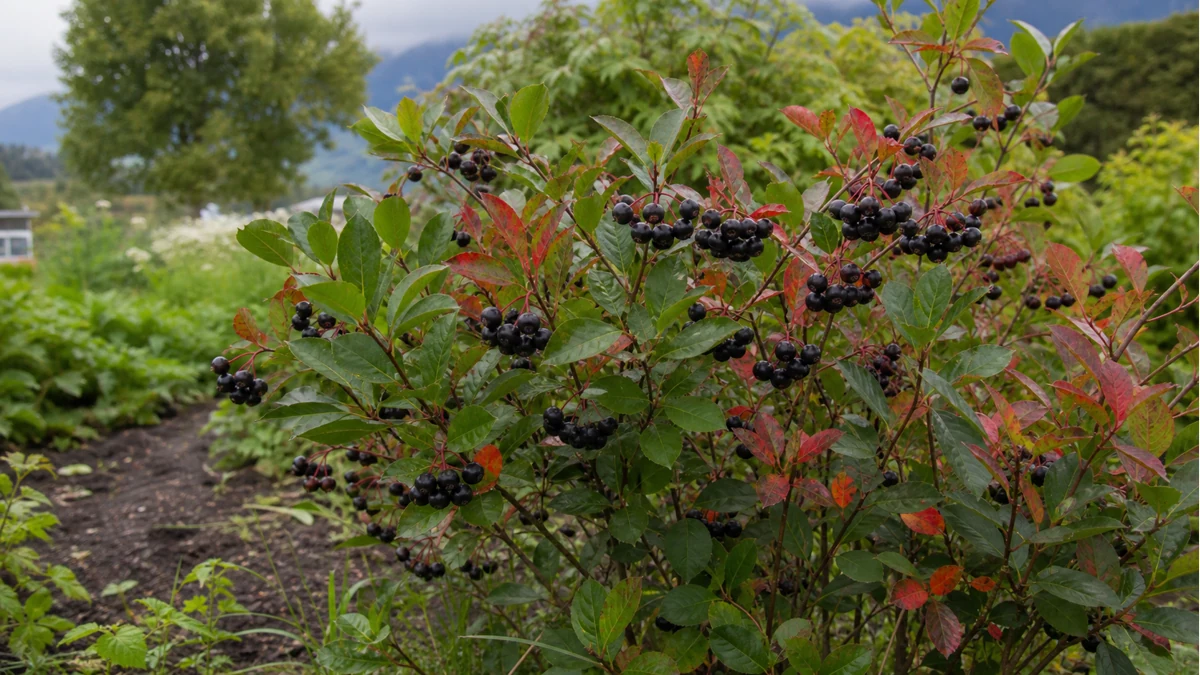
Black chokeberry suits a free hedge better than a dessert-fruit row: the shrub spreads by suckers, colours strongly in autumn and carries very astringent fruit that is usually better kept for juice, jam or jelly than for eating raw. In a general English garden, it is easiest to place where a loose hedge, shrub group or bank planting can stay broad enough for pruning, harvest access and bird netting.
Black chokeberry (aronia): best use and fit
Use black chokeberry where one shrub needs to do several jobs at once: mark a boundary as a free hedge, fill out a shrub group, hold a bank or edge, and still give fruit for the kitchen. The shrub's suckers are part of that value, because they help it knit together into a broader planting rather than a clipped line.
The fruit matters most if you already plan to process it. Raw berries are edible but notably astringent, so the better fit is a household that will turn them into juice, jam, jelly or a mixed preserve with sweeter fruit.
- Best fit: free hedge, shrub group, slope or edge planting, and berries for juice, jam or jelly.
- Strongest selling point: autumn colour with a crop that birds notice if you do not net it.
- Main compromise: berries are useful after processing, not as sweet snack fruit.
When black chokeberry is not a fit
Choose another shrub if your priority is sweet fresh berries, a very narrow clipped hedge, or a row with no room for wandering shoots. Black chokeberry wants a little breadth, and the fruit profile stays tart even when fully ripe.
It is also the wrong low-effort choice if you already know you will not put up bird netting. A free hedge full of dark fruit is easy for birds to spot, and the harvest window can shrink quickly once the berries darken.
- Not for sweet fresh-eating berries.
- Not for a hard-clipped hedge only a little wider than the stems.
- Not for a fruit plan with no bird netting or harvest access.
Site: sun, partial shade and soil moisture
Full sun is the easiest choice if fruit and autumn colour both matter. Black chokeberry will tolerate partial shade, but the crop is usually lighter and the red autumn colour is less dependable in a dull corner.
The species handles a wide soil range, including ground that stays moist for parts of the year and sites that dry between rains. That tolerance does not remove the need for a sensible planting spot: in cooler gardens, give it the warmest open sun you have, and in heavy or damp ground leave enough air around the stems so pruning and drying after rain stay easy.
- Light: full sun for the best fruit and autumn colour; partial shade is acceptable for structure.
- Moisture: moist ground is fine, but newly planted shrubs still need watering in dry spells.
- Soil: adaptable from wet to occasionally dry, provided the planting does not stay stagnant around the root area.
Planting and spacing
Plan the width before you buy. A free hedge can be planted tighter than a shrub group, but the row still needs space to widen through suckers and renewal pruning. If you want a picking edge, leave room to reach both the fruit and the base of old stems.
For a looser shrub group or slope planting, widen the spacing so each plant can colour well and dry after rain. That wider pattern also makes bird netting and late-season harvest much less awkward.
- Use closer spacing for a free hedge and wider spacing for a shrub group.
- Keep harvest and pruning access on at least one easy side.
- Do not push plants tight against a path if you want to manage suckers cleanly.
Seasonal plan
- Spring: plant, water in well and remove damaged or clearly misplaced shoots.
- Late spring to summer: watch the white flower clusters and keep young plants free from competing weeds.
- Late summer to early autumn: check berry colour, net against birds and decide whether the crop is for juice, jam or jelly.
- Autumn: note the red autumn colour and whether the hedge has widened enough through suckers.
- Late winter to early spring: thin older stems if the planting has become too dense.
Pruning: free hedge versus berry access
Prune black chokeberry according to the job it is doing. A free hedge usually needs thinning and occasional width control rather than formal clipping. That keeps the planting broad, flower-bearing and easier to net.
For fruit access, remove some of the oldest stems from the base over time instead of shearing everything flat across the top. That gradual renewal keeps light in the shrub and leaves room to pick without forcing your hands through a thicket of twiggy growth.
- Thin older stems from the base instead of relying on flat shearing.
- Prune for access as much as for shape.
- Keep enough young wood to replace older canes when suckers are removed.
Harvest and use
Treat the berries as a processing fruit. The flavour is astringent when raw, so the practical question is not whether they look dark enough but whether you are ready to press, simmer or freeze them for later use.
Black chokeberry earns its space when the crop becomes juice, jam, jelly or a blended preserve. If you want the fruit rather than the birds to win, put bird netting on before the hedge is fully black with ripe berries.
- Raw flavour: edible but very astringent.
- Best kitchen uses: juice, jam, jelly and mixed preserves.
- Net early enough that birds do not claim the crop first.
Problems to expect
Serious pest or disease trouble is usually low, which is part of the appeal of black chokeberry in mixed gardens. The more common practical problems are birds, crowding from suckers, and a hedge that becomes too dense to prune from the base.
Aphids or leaf diseases can still appear, especially where growth is soft and air movement is poor, but the first correction is usually spacing, thinning and watering discipline rather than heavy intervention.
- Birds are the first harvest problem to plan for.
- Suckers are useful until they block paths or make pruning impossible.
- Aphids and leaf disease are conservative watch points, not the plant's defining weakness.
FAQ about black chokeberry
Can I eat black chokeberry berries raw?
Yes, but expect a very astringent flavour. Most gardeners keep the crop for juice, jam, jelly or another processed use.
Does black chokeberry need full sun?
Full sun gives the best fruit and autumn colour. Partial shade is still workable if the shrub is mainly there for structure.
Is black chokeberry good for a hedge?
Yes, especially as a free hedge. It is less suited to a very narrow, hard-clipped line because the plant spreads by suckers and wants some width.
How do I stop it taking too much space?
Remove unwanted suckers early and thin some older stems at the base. That keeps the hedge manageable without flattening all the fruiting wood.
When should I pick the berries?
Pick when the berries are fully dark and you are ready to process them. Net first if birds are already working the hedge.
What is the main beginner mistake?
Planting it as if it were a sweet berry bush in a narrow slot. Black chokeberry needs room, sun and a plan for bird netting and pruning.
Give a suckering hedge room for tart fruit
Plan black chokeberry as a suckering hedge shrub whose edible berries remain distinctly astringent even when fully dark.
Retain Aronia melanocarpa as the stable plant identity when comparing labels that use black chokeberry or aronia.
A broad hedge leaves room to remove suckers, net the crop and carry tart berries straight to juice or preserves.