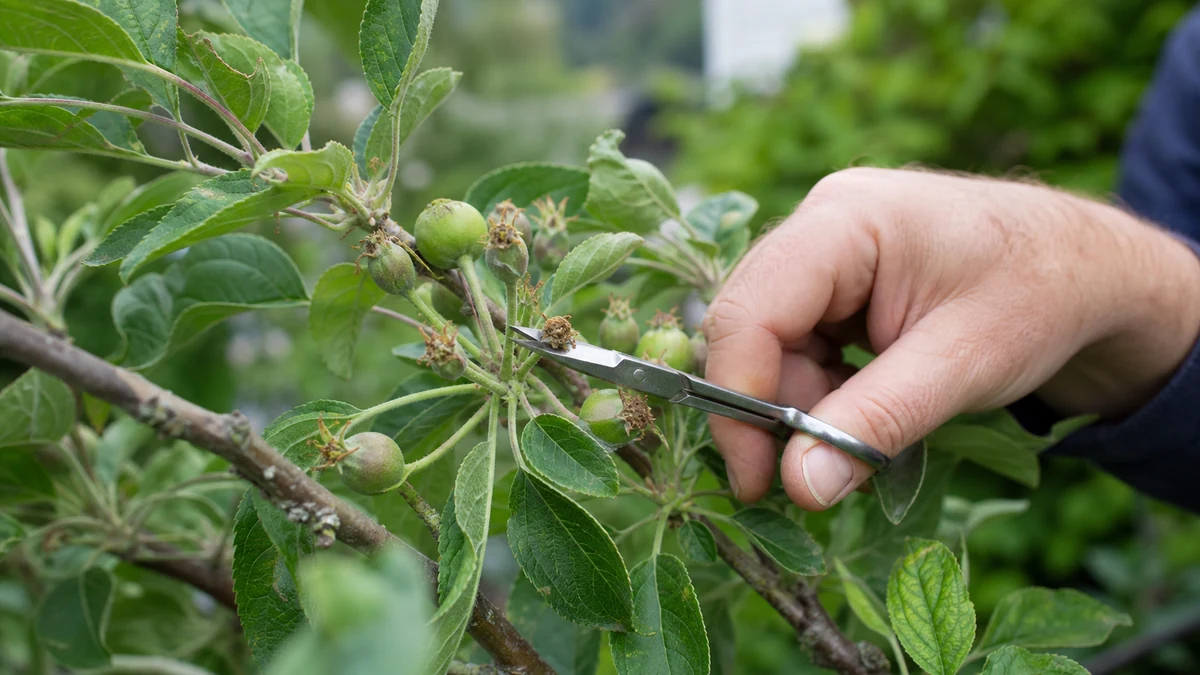
Thin apples only after the tree has shown its real crop load. Wait until after the natural June drop, usually while fruitlets are marble-sized at about 1-2 cm, then adjust the work to bloom timing, local weather and how heavily each branch is carrying.
Quick facts
| Timing | after natural June drop, using bloom timing, local weather and actual crop load |
|---|---|
| Fruitlet size | usually marble-sized, about 1-2 cm across |
| Cluster rule | keep one fruit per flower cluster by default; two only on strong branches with room |
| Spacing | about 10-15 cm for dessert/table apples and 15-23 cm for large cooking apples |
| Tool | small scissors or secateurs to cut stems and protect fruiting spurs |
| Young trees | remove most or all fruit from newly planted or very young trees; thin harder on weak, dwarf, espalier or heavily bending branches |
| Biennial bearing caveat | early thinning can reduce pressure, but frost, pollination, drought, cultivar habit and pruning also matter |
| Disease caveat | remove diseased fruit, fallen leaves and rotten fruit; thinning alone does not control scab |
What apple thinning actually does
Fruit thinning is not a rule to apply to every apple tree every summer. It is a load check: if the tree has set more fruitlets than the branches should carry, you remove the extras while the fruit is still small.
A heavy set can leave many small apples competing on the same spur, especially after a strong bloom and good pollination. Reducing the number of fruitlets gives the remaining apples more room, lowers the strain on bending branches and can help the tree form next year's flower buds.
If frost, poor bloom weather or weak pollination has already left only a light crop, harder thinning will not fix the problem. In that case, leave the sound fruitlets, protect pollinators during bloom and use the season to improve tree health rather than removing more fruit.
- Thin when clusters are crowded, branches are bending or the tree is clearly over-set.
- Do not thin just because the calendar says early summer.
- Leave a light natural crop alone unless individual fruitlets are diseased, damaged or rubbing.
When to thin: after June drop, not by a fixed date
Use bloom date, fruitlet size, local weather and actual crop load instead of a fixed calendar date. Natural June drop is the tree's first adjustment: small fruitlets yellow and fall after the tree has set more than it can carry.
For most home gardeners, the practical window begins after that drop, while the remaining fruitlets are still marble-sized, about 1-2 cm across. This may be several weeks after full bloom, but a cool spring, late blossom, drought or a very light set can move the work earlier, later or make it unnecessary.
Early thinning gives the strongest effect on final fruit size and next year's flower-bud pressure. Later thinning can still reduce branch weight and stop apples from rubbing, but it does less to change how the tree has already allocated growth.
- Wait until you can see which fruitlets the tree has kept after June drop.
- Start when healthy and damaged fruitlets are easy to tell apart but still small.
- Finish before crowded clusters become heavy enough to bend or rub badly.
Which fruitlets to keep in each flower cluster
Start with the worst fruitlets, not with the largest. Remove damaged, misshapen, blemished, insect-damaged, rubbing, shaded or poorly placed fruitlets first. The fruit that remains should hang freely, have room to expand and not press against bark or another apple.
Keep one fruit per flower cluster by default. Two can stay only on a strong branch with enough room between clusters and no obvious bending. A compact dwarf tree, espalier, young tree or weak lateral usually needs the stricter one-fruit rule.
The king fruit is the central fruit in the cluster and is often the largest, but it is a candidate, not a command. Remove the king fruit if it is distorted, marked, pointing into the branch or crowded by a better-positioned side fruitlet.
- First cut out fruitlets with insect damage, scab-like marks, cracks or distorted shape.
- Then remove fruitlets that rub, hang under a shaded spur or press into the branch.
- Keep the soundest, best-placed fruitlet rather than automatically keeping the largest.
Spacing for dessert, table and cooking apples
Spacing is a practical way to check whether the branch can carry what remains. For dessert apples or table apples, aim for about 10-15 cm between apples. That is close to a hand span and usually gives enough room for a good eating apple to size up.
Large cooking apples need more room because the fruit is normally allowed to become bigger. Use about 15-23 cm spacing for large cooking apples, and be more severe where the branch is young, weak or already bending.
Spacing is not separate from the cluster rule. If two apples are left in one flower cluster, the next cluster must still have enough distance, light and branch strength to carry the extra weight.
- Dessert apples and table apples: about 10-15 cm between remaining apples.
- Large cooking apples: about 15-23 cm where the branch can support the fruit.
- Weak, dwarf, espalier or heavily bending branches: keep fewer fruitlets than spacing alone might suggest.
Use scissors or secateurs to protect fruiting spurs
Use small scissors or narrow secateurs, especially on tight clusters. Cut the fruitlet stem cleanly and let the apple fall into your hand or a bucket. This protects the fruiting spur, the short shoot that may carry future flowers and fruit.
Avoid twisting or pulling fruitlets downward. A hard tug can remove the neighbouring apple, tear the spur or damage the cluster base. Work branch by branch so you do not thin one side heavily and then forget the shaded interior.
Clean the tool if you cut diseased fruit or move between visibly infected material and healthy clusters. Put diseased fruitlets and rotten fruit in a disposal bucket rather than leaving them below the tree.
- Hold the cluster steady and cut only the fruitlet stem.
- Keep the short spur attached to the branch.
- Remove and discard diseased or rotten fruitlets instead of dropping them under the canopy.
Young, weak and trained trees need lighter crops
A young apple tree needs roots, a straight trunk and a strong branch framework before it carries a meaningful crop. If a newly planted or very young tree sets heavily, remove most or all fruitlets so growth goes into the tree rather than the crop.
Dwarf trees, cordons, espaliers and apple hedges carry fruit on a smaller structure. They are easier to reach, but the branches and ties can be overloaded quickly. Thin extra hard where shoots are bending, wires are pulling or a branch has not yet thickened enough to carry full-size fruit.
The same rule applies to older trees after drought, root disturbance or heavy pruning: reduce the load on weak sections first and let stronger limbs carry the limited crop.
Light, air and disease caveats
Thinning opens small gaps around each apple, which can improve light, colour and drying inside a crowded branch. It can also stop fruitlets from rubbing and creating wounds where rot can start.
Do not treat thinning as apple scab control. Scab risk depends on variety, leaf wetness, weather, canopy density and sanitation. Remove diseased fruit, fallen leaves and rotten fruit, and keep pruning focused on an open canopy so leaves dry after rain.
If the tree has a history of scab or severe leaf loss, use local plant-health guidance for pruning, resistant varieties and label-compliant local spray advice. Fruit thinning alone does not control scab.
- Remove fruitlets with disease marks or rot while thinning.
- Clear fallen leaves and rotten apples rather than leaving infected material under the tree.
- Use thinning for spacing and crop load; use sanitation and canopy care for disease pressure.
Biennial bearing: thinning helps, but it is not the only lever
Biennial bearing is the heavy-crop, light-crop rhythm many apple trees can fall into. When a tree matures an excessive crop, it may have less energy for flower buds that would feed the following year's harvest.
Early fruit thinning can reduce that pressure, especially on cultivars that naturally over-set. It is still only one part of the system: frost during bloom, pollination, drought, cultivar habit, pruning severity and general tree health also affect whether next year's crop appears.
Keep a simple record of full bloom date, June drop, thinning date, drought stress and harvest load. Those notes are more useful than blaming one season's small crop on thinning alone.
Common mistakes when thinning apples
Most apple-thinning mistakes come from working too early, leaving too many apples in one flower cluster or pulling fruitlets off by hand. The aim is a balanced branch, not a perfectly counted tree.
- thinning before June drop and removing fruit the tree may have shed naturally
- thinning a lightly cropped tree after poor bloom weather or weak pollination
- leaving three or four apples in one flower cluster
- keeping the king fruit even when it is damaged or badly placed
- using the same spacing on dessert apples, large cooking apples and weak dwarf branches
- pulling hard enough to tear a fruiting spur
- assuming thinning alone will prevent scab, rot or next year's light crop
FAQ about apple thinning
When should I thin apple fruitlets?
Thin after the natural June drop, usually when fruitlets are marble-sized at about 1-2 cm. Use bloom timing, fruitlet size, weather and actual crop load rather than a fixed date.
How many apples should I leave in each flower cluster?
Leave one fruit per flower cluster by default. Two can stay only on a strong branch with room, and the spacing to neighbouring fruit still needs to work.
Should I always keep the king fruit?
No. The king fruit is only a candidate. Keep it if it is sound and well placed; remove it if it is damaged, misshapen, crowded or pointing into the branch.
What spacing should I use for apples?
Use about 10-15 cm for dessert apples or table apples and about 15-23 cm for large cooking apples. Thin more heavily on young, weak, dwarf, espalier or bending branches.
Can thinning solve poor pollination?
No. If poor bloom weather or weak pollination caused a light set, harder thinning will not create more apples. Leave sound fruitlets and focus on pollinator-friendly bloom management next season.
Does apple thinning control scab?
No. Thinning can improve spacing and airflow around fruit, but apple scab is managed through resistant varieties, sanitation, an open canopy and locally appropriate plant-health guidance.