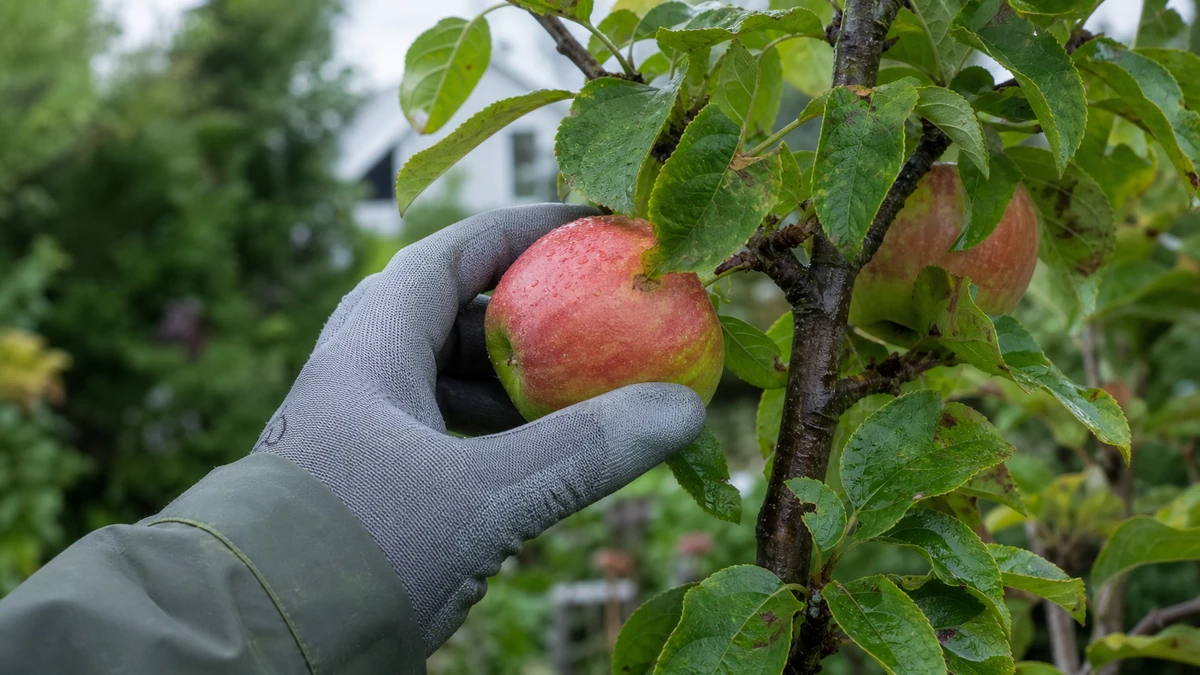
Olive-green to brown, velvety patches on young leaves and dark corky lesions on apples are typical of apple scab. A no-spray garden plan cannot remove existing lesions, but it can reduce the spores carried into spring and shorten the time that new leaves and fruit remain wet.
Recognise apple scab on leaves, shoots and fruit
On young leaves, apple scab often starts as olive-green or brown velvety patches that later darken and develop a clearer edge. Fruit lesions become dry and corky; an early infection can distort the apple or cause the skin to crack.
Shoot scab appears on young wood as bounded grey, blistered areas that may turn corky and split. It is less common on apple than pear, but affected shoots can release spores early in the next season.
- Leaves: look for several olive-green or grey-brown velvety patches on new growth after rain, fog or persistent dew.
- Fruit: check for dry, dark, corky lesions that do not wipe off.
- Shoots: inspect young wood for defined grey areas that become blistered, corky or cracked.
- Do not confuse dry scab with rot: soft tissue, leakage or an abnormal smell points to another problem.
How scab infection moves through the season
In most home gardens, infected fallen leaves from the previous year are the main source of primary infection in spring. Once the litter becomes wet, spores are carried to unfolding leaves, flowers and young fruit.
Spring lesions produce secondary spores. Repeated periods of rain, fog, dew or overhead irrigation can therefore continue the infection cycle through summer and into autumn.
Prioritise the work in this order
A no-spray strategy reduces the inoculum carried into the next season and avoids unnecessarily long periods of leaf wetness. Start with choices that affect several years, then deal with individual pockets of litter and affected shoots.
- When planting: choose a cultivar with lower susceptibility that also suits local winter conditions, ripening season and pollination needs.
- Before spring growth: collect, shallowly incorporate where appropriate, or finely shred as much infected fallen leaf as practical.
- During dormancy: remove obvious shoot scab and rootstock suckers without hard-pruning the whole tree.
- Over several seasons: open the canopy gradually so rain and dew dry sooner.
- When irrigating: water at the base rather than wetting a dry canopy.
Choose a less susceptible cultivar and a site that dries
For a new tree, cultivar susceptibility is the most important long-term decision. Use current regional cultivar advice and treat resistance as reduced susceptibility, not permanent immunity.
Allow the mature canopy space away from solid fences, walls, dense hedges and heavy shade. Sun and air movement cannot prevent rain, but they can shorten the infection window.
Manage fallen leaves before spring spore release
Collect infected leaves, incorporate them lightly where that is suitable, or rake them onto short grass and shred them thoroughly before bud break. The objective is to leave fewer intact infected leaves wet and undisturbed beneath the tree.
Fine shredding only works well when most of the litter is reached. First rake leaves out from the trunk, low branches, borders and shrubs, then make more than one mower pass and inspect the result.
- After leaf fall: expose hidden leaf pockets and choose collection, shallow incorporation or fine shredding.
- When shredding: work on short grass, make several passes and check that large intact leaves are not left behind.
- Before bud break: make a final pass through damp corners the mower did not reach.
Remove obvious shoot scab and rootstock suckers
Cut out clearly affected shoots and remove suckers from below the graft, because both can carry infection into the new season. Cut back to healthy wood or a sound branch junction and remove the prunings from beneath the tree.
Do not use scab as a reason to cut the whole canopy hard in one year. Severe pruning often produces many upright water shoots and recreates a dense mass of susceptible leaves.
Keep the canopy open and water at the base
Keep the canopy open enough for rain and dew to dry sooner, and water at the base rather than prolonging leaf wetness. Remove dead, crossing and strongly inward-growing branches first, then spread structural work over several dormant seasons.
A young tree needs reliable water while it establishes, but excessive nitrogen can also drive soft, crowded growth that is harder to keep dry and open.
Scabby apples are often usable
Apples with only dry, superficial scab lesions can usually be eaten or processed; light scab commonly affects appearance more than flavour. Wash the fruit and trim the damaged skin if the intended use calls for it.
Keep cracked, soft or rotting fruit out of long storage. A scab-related crack provides an entry point for fruit rots even when the rest of the apple initially looks sound.
These steps reduce risk but do not control the weather
The measures reduce local inoculum and leaf wetness, but they cannot guarantee spotless fruit in a wet season or stop spores arriving from nearby apple trees. Existing lesions do not disappear.
Judge the result across at least two seasons. If a highly susceptible tree remains badly affected after consistent leaf-litter work, removal of obvious shoot scab and improved drying, the cultivar or site may be the main constraint.
Seasonal plan for apple scab without sprays
- At harvest: note the cultivar, tree and branches with the most scab; do not store cracked or rotting fruit for long periods.
- After leaf fall: collect, incorporate or finely shred infected leaves, including material initially beyond the mower's reach.
- During dormancy: inspect for shoot scab, rootstock suckers, dead wood and overcrowded canopy sections.
- Before bud break: remove intact damp leaves still lying by the trunk, under shrubs or along bed edges.
- From bud break through fruit set: inspect young tissue after wet weather, because early lesions can start secondary infection.
- Through summer: water at soil level, watch how quickly the canopy dries and record whether new lesions continue.
Questions and answers about apple scab
Does apple scab disappear by itself?
Lesions that have already formed do not disappear. Leaf-litter work, removal of affected shoots and faster drying are aimed at later infections and the following spring.
Must every fallen apple leaf be removed?
No. Reach as much infected litter as practical, especially intact leaves that stay damp beside the trunk, under low branches and along borders.
Does mowing over the leaves help?
Yes, when the leaves are shredded finely and most of the litter is reached. Rake hidden leaves into the open first and make several passes.
Can scab come from a neighbour's apple tree?
Yes. Work in one garden reduces local inoculum but cannot control every spore released by nearby trees.
Should a badly affected tree be removed?
Not automatically. First try leaf-litter management, removal of obvious shoot scab and suckers, and better canopy drying.
Can I eat apples with scab?
Yes, when the damage is dry and superficial. Use cracked fruit promptly and discard apples that are soft, rotting or smell abnormal.
Are any apple cultivars completely immune?
Some cultivars are highly resistant, but no permanent guarantee is secure. Use current regional cultivar information and combine resistance with sanitation and drying.
Next step: choose one job before bud break
Photograph leaves, fruit and young shoots and record the cultivar if known. Then choose one concrete task: decide how to handle fallen leaves, mark shoots with obvious scab or plan a gradual opening of the canopy.