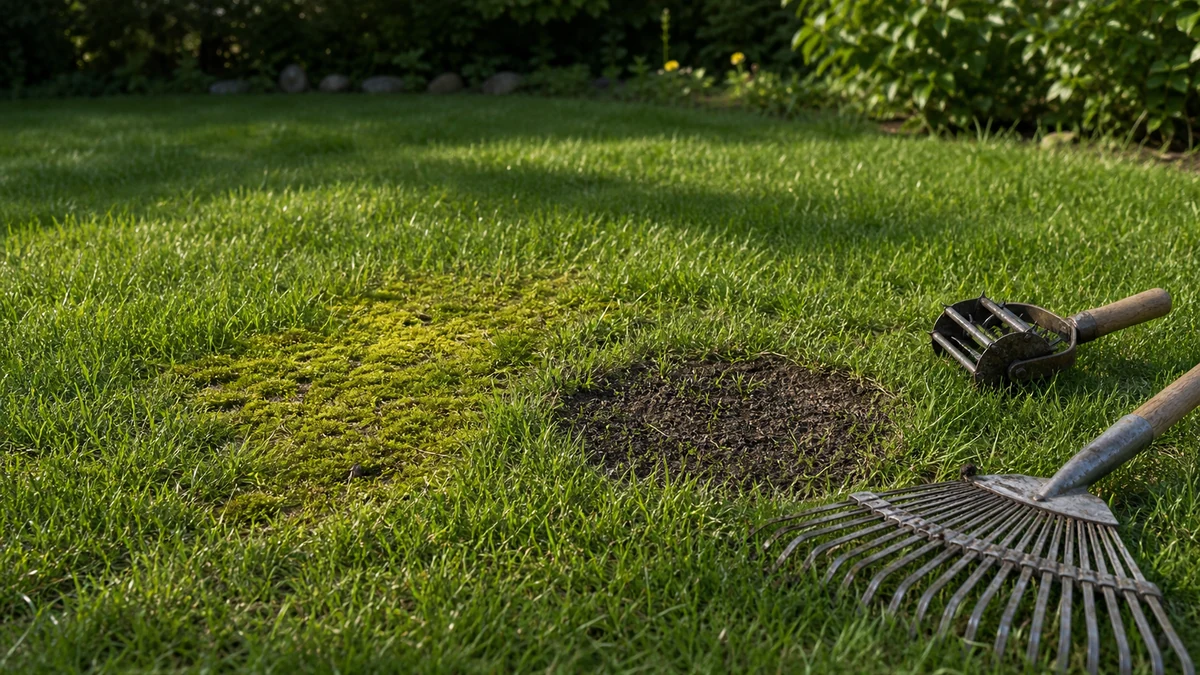
A temperate-climate lawn can carry three different stories within a few strides: moss beneath the hedge where afternoon light never arrives, a compacted route between the door and shed, and a pale repair patch whose young roots dried during a regional rainless spell. Treating the whole area alike hides those distinctions. Read the surface after rain, compare roots with a healthy control, and separate established turf from the seedbed before deciding what work is justified.
Give each symptom an address
Begin on a day when the ground is neither sodden nor powder-dry. Mark one dense, healthy piece of turf as the control, then mark the moss edge, the walking route and the failed repair. Pour the same small amount of water onto each marked spot and watch whether it sinks, pools or runs sideways. This simple comparison is more useful than judging colour alone, because drought, shallow soil and waterlogged roots can all produce weak grass.
Lift a narrow wedge at the edge of each mark and compare rooting depth, soil smell and the boundary between turf and mineral soil. A shiny, dense layer with shallow roots supports a compaction diagnosis; loose soil with dry young roots points elsewhere. Record how many hours the shaded strip actually receives direct light. The result is a map of separate constraints, not a shopping list for the whole lawn.
- Infiltration: compare equal amounts of water on healthy and damaged ground.
- Roots: look for depth, branching and an abrupt hard layer below the turf.
Let growth set the mowing interval
Mowing frequency should answer the grass, not a recurring alert on a phone. During active, moist growth, the interval shortens; during regional drought or cold, it lengthens. Remove no more than roughly one third of the leaf in one pass, and postpone the cut when the surface is wet, frosted or too soft to carry the mower without marking it. A higher setting protects more leaf area when water is limited and reduces the chance of scalping raised ground.
An established lawn and a new seedbed cannot be managed as one surface. Established cool-season turf may lose colour and slow down during dry weather, so stopping the mower can be the responsible choice. Germinating seed has only a tiny moisture reserve. Water that patch gently enough not to move the seed, and check it directly rather than watering the entire established lawn merely to preserve an uninterrupted green colour.
- Cut because leaves are growing, not because a particular month has begun.
- Use sharp blades and avoid repeatedly turning the mower on the same soft corner.
- Pause during drought rather than forcing a low, cosmetic finish.
Open the compacted route before repairing its surface
The bare line from a patio to a gate is often a traffic problem before it is a seed problem. If water remains on that line while the control absorbs it, and the soil wedge shows shallow roots above a dense layer, reduce traffic while the soil is wet. Create a temporary route or place access elsewhere during recovery. Seed scattered over an unchanged footpath will be pressed, scuffed or deprived of air before it forms durable turf.
Aerate only a documented compacted zone during active growth, when moist soil penetrates yet crumbles. Core removal cannot correct a blocked drain, buried layer or continuing traffic.
- Redirect repeated walking before asking new grass to occupy the route.
- Test penetration beside the route so ordinary soil resistance is not mistaken for compaction.
- Treat persistent ponding as a level or drainage question, not an aeration target alone.
Decide whether grass is realistic in the moss edge
Moss commonly occupies turf weakened by shade, prolonged surface moisture, close cutting, wear or compacted soil. Removing the visible mat changes the surface but not the light or drainage that favoured it. Rake a small test strip only while the surrounding grass is growing strongly, then improve the specific constraint you found. If the strip remains wet and dark, repeated removal will keep exposing soil without making the site better for lawn grasses.
There is also a legitimate design choice. Moss can form a soft, low cover in conditions where short-cut grass performs poorly, while a shade-tolerant planting may make a more resilient edge. A uniformly green surface is not automatically evidence of healthy turf or responsible water use. Decide what that corner must do—carry feet, frame a border or simply cover soil—before committing it to a grass standard that the site cannot sustain.
Lime only after a soil test has shown a pH need. The green moss itself does not measure acidity, and changing soil chemistry cannot add sunlight, relieve traffic or provide an outlet for water.
- Retain moss where it meets the use and the site cannot support dense grass.
- Raise the cut and reduce wear where grass still has adequate light.
- Change the expectation if the same shaded edge stays wet after every rainfall.
Read weeds as plants, not as one category
A dandelion rosette in open turf asks a different question from low plants filling a scuffed path. Where a few dandelions are unwanted, loosen moist soil beside the crown and remove as much of the taproot as practical without excavating a broad crater. Root fragments can regrow, so revisit the exact point and remove young regrowth. That is honest control; one pass cannot promise permanent removal.
After lifting a plant, close the opening with soil similar to the surrounding root zone and seed only if the gap is too wide for adjacent grass to close. Where many weeds trace the traffic line, improve access and turf density first. Some flowering plants can remain in less formal areas if they fit the lawn's use. The decision is about function and competition, not a requirement that every non-grass leaf disappear.
- Identify the dominant plant before choosing a mechanical response.
- Remove deep-rooted plants when soil releases the root rather than snapping it.
- Accept follow-up observation instead of expecting permanent weed removal.
Build a seedbed inside the old lawn
A bare patch must be prepared as a small seedbed, even though established turf surrounds it. Remove loose dead material and investigate the cause below it. Loosen only enough soil to create a level, crumbly surface with contact between seed and earth. Divide the measured seed for the patch and scatter it from two directions, then rake lightly. Firming means securing contact; it does not mean packing wet soil until its pores collapse.
Use a gentle spray when rainfall is insufficient, because a forceful stream sorts seed into the low edge. Check moisture in the repair itself. Regional temperatures, rainfall and the seed label determine timing, so British spring and autumn dates or Minnesota late-summer dates are examples of suitable conditions in those places, not universal appointments. Choose a window of active growth with enough mild, moist weather for roots to establish.
Delay the first cut until seedlings resist a light tug and have enough leaf to lose only a small share.
- Match seed to shade and wear rather than choosing only for fast germination.
- Keep seed in contact with fine soil without burying it under a thick layer.
- Protect the patch until rooted seedlings can tolerate ordinary use.
Separate a surface ripple from a drainage hollow
A shallow ripple that stays dry can be adjusted gradually while grass remains visible through a thin addition. Choose soil compatible with the existing root zone and brush it between the leaves. No fixed topdressing formula fits a free-draining profile, a heavy compacted layer and a newly prepared seedbed. Observe infiltration after each small correction before adding more.
A depression that collects water requires a route for that water. Check roof discharge, edging, hard surfaces and the fall beyond the hollow before filling it. Soil added to a depression should resemble the existing soil so it does not create an abrupt layer that impedes movement. Where ponding persists, drainage or regrading comes before reseeding; otherwise the attractive new surface conceals the original failure.
Do not press or reshape uneven ground while the soil smears underfoot. Wait until the profile is dry enough to carry the work, then lift and rebuild a local hump or hollow before pressing only enough to restore contact.
- Dry, slight ripple: adjust in thin stages while leaves remain exposed.
- Wet hollow: solve the water route before replacing turf or seed.
- Soft ground: postpone machinery until the profile is firm underfoot.
Use a growth window, not a borrowed calendar
- After winter or prolonged rain: wait for the root zone to drain and support a footprint before raking, mowing or moving soil.
- During active spring growth: adjust mowing, remove isolated weeds and repair only patches that can receive establishment water.
- During regional drought: leave the mower higher or idle, reduce traffic and direct scarce water to vulnerable seedbeds rather than colour alone.
- When late-summer or autumn conditions become mild and moist: tackle documented compaction and larger repairs only if roots still have time to establish locally.
Questions to settle before lawn work
When should I aerate a compacted lawn?
Aerate only after infiltration and a soil profile indicate compaction, while the grass is actively growing and the soil is moist but not saturated. Regional timing differs; a fixed British or Minnesota month is not a universal rule.
Does moss mean the soil is too acidic?
No. Shade, prolonged moisture, close mowing, weak turf and compaction can favour moss. Lime only after a soil test has shown a pH need; visible moss is not a test result.
Should an established lawn stay green through drought?
Not necessarily. Established turf may slow and lose colour, while a seedbed has little moisture reserve. Follow regional water restrictions and protect young repairs before spending water solely on the colour of mature grass.
Why did a bare repair fail even though the rest survived?
Young roots occupy a much smaller soil volume than established roots. Check seed-to-soil contact, gentle watering, heat, shade and traffic in the patch instead of assuming the surrounding lawn and seedbed had equal resilience.
Can one topdressing mix level every lawn?
No. The added soil should suit the existing profile, and a hollow that ponds needs drainage or grade correction first. Work in thin stages that leave grass exposed rather than relying on a fixed material formula.
Mark four small areas before buying materials
Place one marker in dense turf that performs the job you want. Put three more in the shaded edge, compacted route and dry repair. Photograph each from the same position, note direct-light hours, compare water entry and record how deep roots reach. Those four observations turn vague dissatisfaction into separate questions that can be answered without treating unaffected ground.
Choose the smallest repair strip that represents one problem, then compare it with the control after a full period of active growth. If infiltration improves but traffic remains, the route will still fail; if seed establishes but the moss strip stays dark and wet, the site expectation needs changing. Observation across a season is the last maintenance tool, and it costs less than repeating an unsupported intervention.
- Label the control and problem areas so later photographs mean something.
- Change one cause in the trial strip, not several variables at once.
- Judge roots, density and water movement as well as colour.
- Expand the repair only after the local result survives ordinary use.