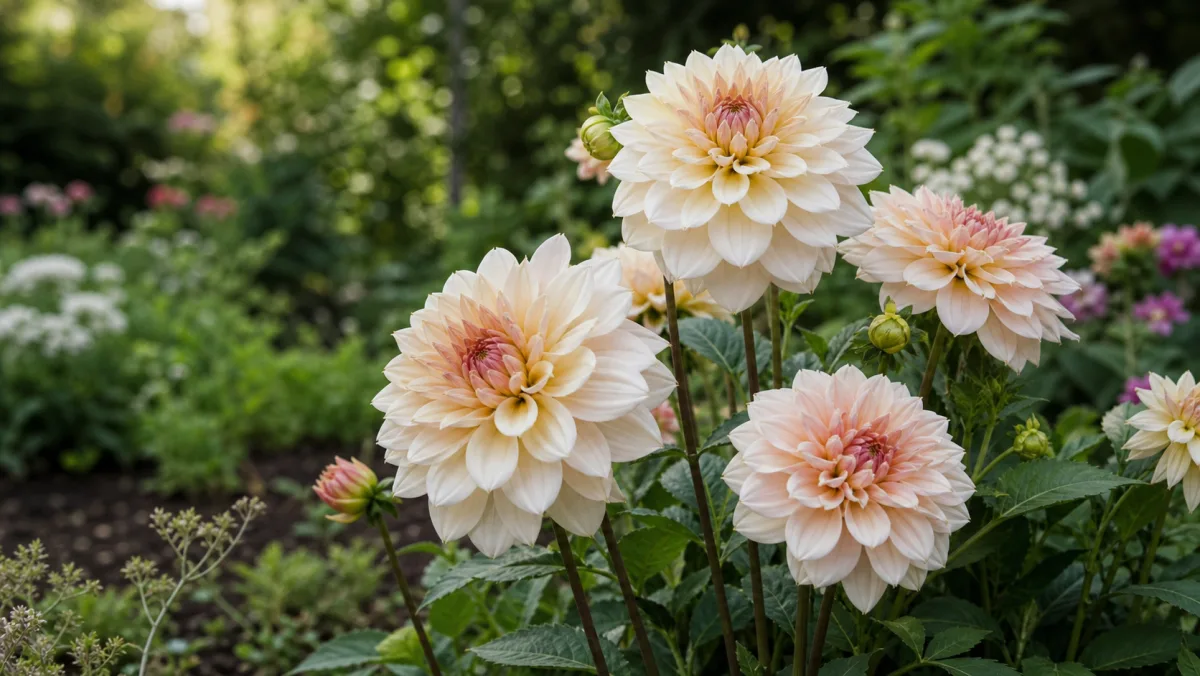
‘Café au Lait Royal’ has its own registered cultivar identity. It arose as a sport of ‘Café au Lait’—a spontaneous variant selected and maintained separately—and the 2020 register records flowers up to 160 mm with pale, purple-blushed and pink-purple markings. Those observations distinguish the plant; they do not guarantee that every bloom will match a seller's photograph. The practical response is simple: retain the full name on the pot, support the large flowers before they open, and return the same label to the stored tuber at the end of the season.
Dahlia 'Café au Lait Royal': A sport is a separate selection, not a styling word
‘Café au Lait Royal’ is registered as a sport of ‘Café au Lait’, not as another spelling of the parent cultivar. A sport begins as a distinctive shoot or flower on an existing plant; when that difference is stable and propagated, it can be maintained under a separate cultivar name. Dropping ‘Royal’ therefore loses useful identity information.
The register places it in decorative group 5 and records a flower up to 160 mm. Its colour notation includes white to very pale ground colour, light-purple blushes and stripes, and stronger reddish-purple or pink tones on the reverse and lower portions. Read that as a bounded record of submitted material, not a recipe for an identical flower under every light and temperature.
Photograph the original label before planting and use a second weatherproof label at the root. The duplicate matters most in a mixed Café au Lait planting, where foliage and dormant tubers offer few reliable visual clues.
Follow one name through the whole season
- At potting or planting: copy the complete cultivar name before labels are separated from their packages, and choose a sunny position with free drainage.
- During rapid stem growth: fit a grid or branching support while the shoots can still be guided without snapping, leaving a clear route for cutting stems.
- As flowers open: compare the overall pale and purple-pink pattern, not one photograph; cut fully open flowers and deadhead spent blooms to a leaf junction.
- After frost or seasonal dieback: move the durable label with the tuber and store it cool, dark and frost-free where local winter conditions make lifting necessary.
Give the flower load a stable root volume
A border provides the most stable moisture and anchorage where the soil drains freely. Place the tuber far enough from a path that a flower recorded to 160 mm is not brushed on every pass, yet close enough that you can deadhead and cut without leaning through neighbouring plants.
A container is workable when it is broad, heavy and deep enough to hold a support securely. A narrow decorative pot may look proportionate to a dormant tuber but becomes top-heavy once several large flowers are wet. Do not block the drainage hole with a stake or allow the pot to sit continuously in collected water.
In either setting, water the root zone slowly during dry periods. Surface mulch can moderate drying in a bed, while a pot needs frequent checks because wind and a dense leaf canopy can remove water quickly.
- Choose anchorage before colour placement.
- Keep the crown drained while maintaining even root moisture.
- Reserve hand access to the centre of the clump.
Cut the open flower without sacrificing the framework
Dahlia buds do not continue opening in a vase in the way that some common cut flowers do. Select a fully open, firm flower. A longer stem often requires cutting back to a branching point, so decide whether the next shoots will still leave a balanced plant before making the cut.
Before taking a long stem, inspect the side shoots below it and the route through the support. One deliberate cut can preserve a useful branch; a series of short cuts can leave bare stalks buried inside the framework.
Deadheading follows the same navigation principle. Trace a spent flower down to a useful leaf joint instead of leaving a string of bare stalk. This keeps the branching framework easy to see and reduces the chance of mistaking an old stem for a new cutting stem.
Store the cultivar, not just an anonymous tuber
Where winter soil freezes, remains saturated or repeatedly thaws and refreezes, lifting is the safer way to preserve the named plant. Let excess soil dry enough to handle, remove damaged material with clean tools and keep separate cultivars physically separated during processing.
Store the tuber cool, dark and frost-free in a breathable arrangement. Check periodically: isolate spreading rot and respond to severe shrivelling before the tuber is lost. Warm, airtight storage encourages a different set of problems than a cool but freezing shed.
Tie the label to the storage unit rather than laying it loosely on top. The aim is not merely to keep a dahlia alive; it is to know that the pale purple-striped flower returning next year is still ‘Café au Lait Royal’.
Questions about ‘Café au Lait Royal’
Is ‘Café au Lait Royal’ the same as ‘Café au Lait’?
No. The register lists ‘Café au Lait Royal’ as a sport of ‘Café au Lait’: a selected spontaneous variant with its own cultivar identity. Keep the complete name on every label.
What colour should the flowers be?
The registration records a pale base with light-purple blushes and stripes, plus stronger reddish-purple and pink on the lower surface. Conditions and flower age change the balance, so use the description for identity rather than as a screen-perfect colour guarantee.
How large are the flowers?
The registered maximum is 160 mm, but that is not a promise that every bloom in every garden will reach it. Use the figure to plan flower scale and support.
When should I cut the flowers?
Cut when a flower is fully open and firm. Trace the stalk to a branching point and check which side shoots will remain before taking a long stem.