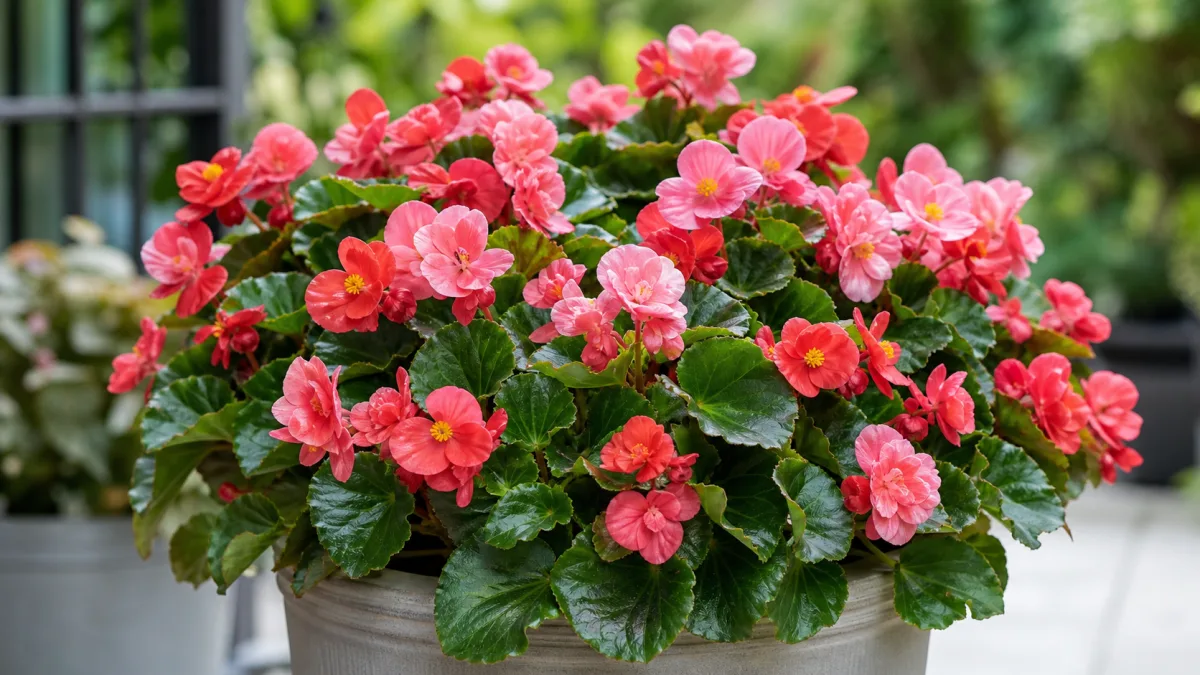
‘Betulia’ does not identify one interchangeable plant in every shop. The name began with a compact red-flowered cultivar whose spreading roots do not form tubers; today it also covers several named colour variants. One red-flowered plant therefore cannot define every Betulia sold now, and dry storage borrowed from a tuberous begonia is the wrong winter plan. Read the complete variant label first, then manage this flowering pot plant with bright shade, free drainage and water directed to the root zone.
Betulia is a named range, not one red begonia
The original red ‘Betulia’ was observed at about 25–28 cm high and 30–34 cm wide in four-month-old plants grown in 17 cm pots. Temperature, light and day length can change the finished plant, so those conditional observations are identity history rather than a size guarantee.
Today's Betulia range contains several variants, each with its own colour name. The selection can change over time, so record the full pot label before discarding the sleeve instead of relying on a fixed list of colours.
The original cultivar has spreading roots that do not form tubers. That is the practical dividing line: do not lift, dry and pack a Betulia as though it were a tuberous begonia unless its own verified label says otherwise.
Use bright shade to balance heat and moisture
A position with bright indirect light or gentle morning sun supports flowering without exposing the leaves to hot afternoon sun. Check how the light moves across the site before placing the pot permanently.
Watch the plant and the potting mix together. A wilt at the hottest hour does not by itself prove dry compost; check below the surface before watering again. Shade and overwatering solve different problems, so do not use one as an automatic response to the other.
Indoors, keep the plant near useful daylight. Outdoors, use a shaded position protected from high winds, because begonia foliage and flowers can be fragile. Allow air to circulate without turning the position into a drying wind tunnel.
- Keep the pot out of hot afternoon sun.
- Check the root mix before responding to wilt.
- Protect fragile foliage and flowers from high winds.
Questions about Betulia begonias
Is Betulia one red begonia or a collection?
Both uses occur. The original patented ‘Betulia’ was a single red cultivar, while the current Betulia range includes several separately named colour variants. Read the complete variant label before relying on colour or habit.
Does Betulia form a tuber for dry storage?
The original cultivar has spreading roots that do not form tubers. Do not apply dry-tuber storage instructions to a Betulia simply because another begonia is tuberous.
How much sun does a Betulia begonia need?
Use bright shade or gentle morning sun, and protect it from hot afternoon exposure. Check how light moves across the position and how quickly the potting mix dries.
How should I water a Betulia begonia?
Water the potting mix at the base when it needs moisture, let excess drain and empty any outer pot. Avoid routinely wetting flowers and leaves or keeping the root ball continuously saturated.
A five-minute pot and foliage check
- Read the label: note Betulia plus the named variant, and photograph the front and back while care symbols remain legible.
- Lift or touch the pot: check moisture below the surface rather than watering automatically by weekday.
- Water at the base when needed: soak the root ball evenly, allow drainage and remove collected water from a cover pot or saucer.
- Inspect the canopy: remove spent flowers and damaged leaves, keep the soil surface clean and maintain air movement around the crown.
Keep living roots aerated through winter
Use a clean, free-draining potting mix in a container with an open drainage hole. Water the mix rather than pouring through the flower canopy, then let excess escape. Constantly saturated compost excludes air and raises the risk of root and stem decline; repeated tiny sips can leave the lower root ball dry.
Remove collapsed flowers and leaves before they mat against the crown. Space plants so air can pass between them, particularly in humid indoor displays or under a sheltered roof. Good air movement is not a reason to expose the plant to a drying draught.
Before cold weather, move a container-grown Betulia to frost-free conditions with useful light. Reduce watering as growth slows but continue checking the non-tuberous root ball; do not dry it into dormancy as a loose tuber.