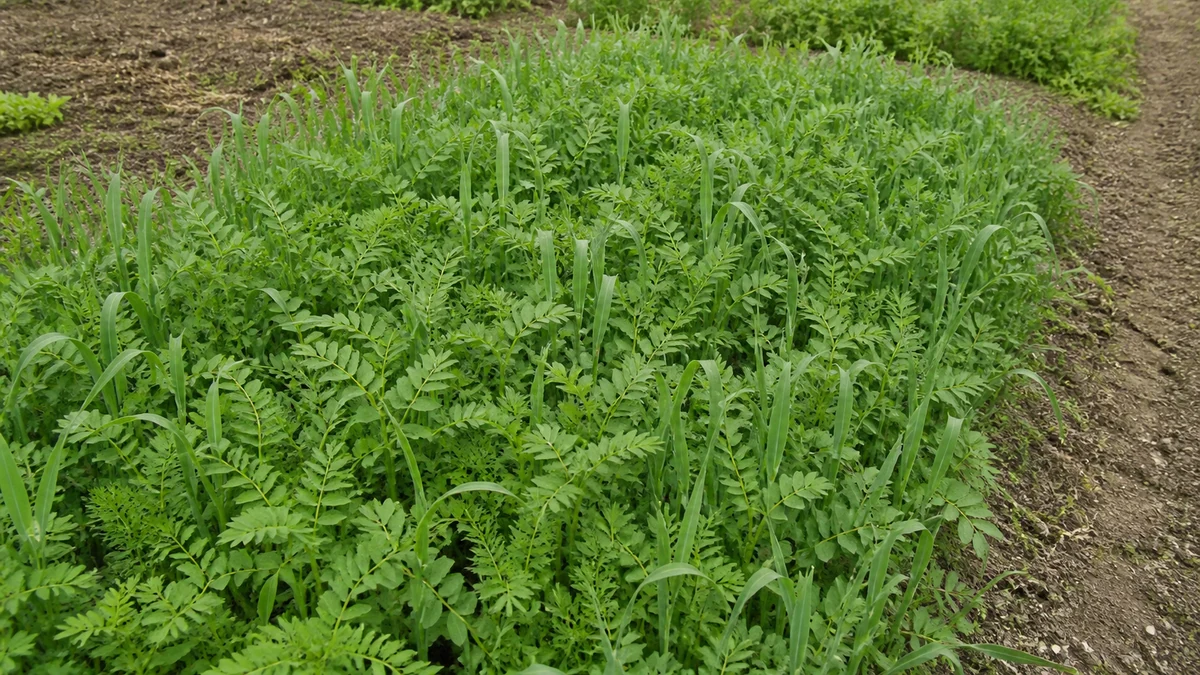
A green manure is grown for the soil rather than for harvest. Oats, phacelia, clover, vetch, rye and forage radish do different jobs, and only legumes can add nitrogen fixed from the air. Start with what you want to grow next, how much of the season remains and how you will cut down or cover the green manure.
Choose the purpose before choosing the seed
Green manuring means using a crop to protect and improve the soil rather than to produce a harvest. When a bed becomes free after early potatoes, salads or peas, a new sowing can keep the surface covered, hold nutrients in roots and shoots, and return organic matter when the crop is cut down.
Work backwards from the next crop. A fast summer cover has a different role from clover given most of a season, and overwintering rye must be dealt with in spring, whereas oats may be killed by winter weather. Local winters determine whether winter kill is reliable, so never treat it as the only plan in a mild area.
- Fast cover in a vacant summer bed: oats, phacelia or buckwheat where the season is warm enough.
- Biological nitrogen fixation: clover, vetch, field peas or another legume, often mixed with a faster cover crop.
- Capture residual nutrients after harvest: use a rapidly establishing non-legume and sow while enough growing time remains.
- Winter cover: use rye or winter vetch only when you already know how you will cut it down or smother it in spring.
- Flowers for pollinators: allow phacelia or clover to bloom, but cut before seed matures if self-sowing is unwanted.
- Before brassicas: avoid mustard and forage radish when they make the brassica rotation too tight or clubroot is a concern.
Nitrogen fixation and nutrient capture are different
Green manure describes what happens to the biomass: roots and shoots remain on site, are composted, used as mulch or incorporated shallowly. Cover crop describes the living plant's task while it grows, such as protecting bare soil, suppressing small weeds or retaining nutrients that might otherwise be lost.
The same crop of oats can therefore be both a cover crop and a green manure. It captures nitrogen already in the soil and later returns plant material. Clover and vetch add another process: bacteria in root nodules can convert atmospheric nitrogen into a form the plant can use. Oats, rye, phacelia and radish do not fix nitrogen.
None of these benefits is automatic. Seed sown too late, into dry soil or without firm soil contact produces little root and shoot growth. A patchy crop cannot provide the cover, weed competition or nutrient capture promised by a vigorous crop.
Practical species choices
Oats have large seed, establish quickly and are easy to assess. They suit a bed released after an early harvest when you want cover without committing to a very persistent spring crop. In cold winters oats may die and leave a manageable mat, but winter kill is not dependable in every region or every year.
Phacelia also establishes quickly in warm soil and sits outside the pea, grass and cabbage families. It can provide flowers for insects, but flowering creates a trade-off: older stems are slower to decompose and seed allowed to mature can lead to self-sown plants. Decide whether the priority is soft biomass, flowers or the longest possible soil cover.
Clover, vetch, peas and beans are legumes. With suitable rhizobial bacteria they form root nodules and fix nitrogen from the air. When roots and shoots decompose, part of that nitrogen can become available to the following crop.
Rye germinates in cooler conditions than many summer species, survives many winters and can make a dense root system. That makes it useful after a late harvest, but vigorous rye in spring also competes for time, water and space before the next crop.
Mustard, oilseed radish and forage radish establish quickly and can make strong taproots. Those roots explore deeper soil and leave channels after decay, but they do not repair waterlogging, severe compaction or a hardpan by themselves.
Sow evenly and prioritise seed-to-soil contact
Remove couch grass, ground elder and other perennial weeds first. A cover crop may shade small annual weeds, but it makes established root weeds harder to remove once the bed is dense.
Use the packet rate as the starting point. Agricultural rates are often given per hectare or acre for machinery and should not be converted blindly to a raised bed. Oversowing wastes seed and increases competition; undersowing leaves gaps for weeds.
Large seeds such as oats, peas and vetch usually establish better in shallow drills. Fine clover and phacelia seed belongs much nearer the surface. Follow the species guidance, firm lightly and water gently enough that seed is not washed into low spots.
- Split one bed into two test areas if you want to compare a single species with a mixture.
- Label the sowing date and mixture; after winter it is easy to forget what was expected to die.
- Water for establishment according to moisture in the seed zone, not a fixed calendar.
- In hot, dry climates, wait for reliable rain or provide irrigation rather than sowing into dust.
Keep plant families in the crop rotation
Green manures are still crops. Count clover and vetch with peas and beans, and mustard or radish with brassicas. Repeating one plant family can maintain pests and soil-borne diseases even when the crop is not harvested.
A ready-made mix is not automatically neutral. Read every species on the packet and reject a mixture that puts the wrong plant family into the planned rotation.
Decide how you will clear the crop before sowing
The simplest option is a species that reliably dies in the local winter and leaves only a thin residue. Where winter kill is uncertain, inspect the bed and be ready to cut regrowth before it becomes fibrous.
Cut a living crop before the seed matures. Chop coarse material, let it wilt briefly and spread it in a moderate layer. Incorporating a thick fresh mat deeply can create poorly aerated pockets and slow, uneven decomposition.
Digging is optional. Residue can remain as surface mulch, go to the compost heap or be smothered with cardboard or an opaque tarp. A no-dig approach still requires checks for regrowth around edges and planting holes, and for slugs under damp residue.
Plan the bed from harvest to the next crop
Plan the whole bed cycle before sowing. A green manure is useful only when it establishes well and can be cleared in time for the next crop.
- Before sowing: choose the primary job, the following crop and the latest realistic date for cutting or covering the crop.
- At sowing: remove perennial weeds, level the surface, distribute seed evenly and create direct contact with moist soil.
- Establishment: keep the seed zone moist until roots are anchored; a patchy crop neither protects the soil nor suppresses weeds well.
- Growth: watch for drought, slugs, early seed set and one species taking over a mixture.
- Clearing the crop: cut before seed matures, chop coarse growth and stop regrowth with another cut or an opaque cover if needed.
- Before the next crop: allow fresh incorporated residue to decompose and clear tough material from fine seed rows.
Allow time before sowing small-seeded crops
Fresh green material can release compounds that suppress germination and early root growth while it decomposes. Agropub describes effects lasting three to four weeks at a soil temperature of 15°C, while the RHS uses about a month as a practical interval after digging in.
For a vegetable bed, two to four weeks is a useful planning range. Use the longer end for direct-sown carrots, salad and other small-seeded crops, for cool soil and for coarse rye or grass residue. Wait longer if the bed smells sour, stems remain in tough clumps or regrowth is not controlled.
Young leafy and legume-rich material generally breaks down faster than old stemmy grass. That does not make a thick wet layer desirable: excessive biomass can exclude air and lose nutrients. Move surplus material to the compost heap or another bed with a clear need.
Questions and answers
Can green manure replace fertiliser?
Not on its own. Legumes can add nitrogen fixed from the air, while oats, rye and phacelia mainly retain nutrients already in the soil. The result depends on how much root and leaf growth you produce, how the crop is cleared and what you grow next. Treat green manure as one part of soil and fertility management, not as a guaranteed replacement for compost or fertiliser.
Which green manure is easiest for a beginner?
Oats are often the easiest first try when a bed becomes free while the soil is still warm enough for germination. The seeds are large and the growth is easy to follow. Cut before the seed heads mature, and check the bed in spring rather than assuming that every plant has been killed by winter.
Can I sow green manure in autumn?
Yes, provided the crop still has enough warmth, moisture and daylight to make roots and leaves. Oats or phacelia suit a short cover that may die in winter; rye is chosen deliberately for overwintering and must be cleared in spring. Follow local conditions and the seed packet rather than one universal autumn date.
Must green manure be dug in?
No. Cut it and leave a moderate surface mulch, compost the biomass or smother regrowth with an opaque cover. If fresh material is incorporated, chop it and keep it shallow so the material decomposes with enough air.